
As autonomous AI agents transform every industry from healthcare to finance, millions of professionals face a critical question: How do you stay relevant when machines can automate increasingly complex tasks? The answer lies in mastering human-AI collaboration rather than competing against artificial intelligence.
This guide is for working professionals, career changers, and recent graduates who want to future-proof their careers in our rapidly evolving AI-driven workplace. Instead of fearing displacement, you’ll learn how to position yourself as an irreplaceable partner to AI systems.
We’ll explore how to identify your unique human advantages over AI—like emotional intelligence, creative problem-solving, and ethical reasoning that machines can’t replicate. You’ll discover practical AI collaboration skills that make you more valuable, not redundant. Finally, we’ll cover proven career pivoting strategies and actionable steps to begin your AI integration journey, ensuring your career development in the AI age leads to growth rather than obsolescence.
The future belongs to professionals who can work alongside artificial intelligence, not those who ignore it.
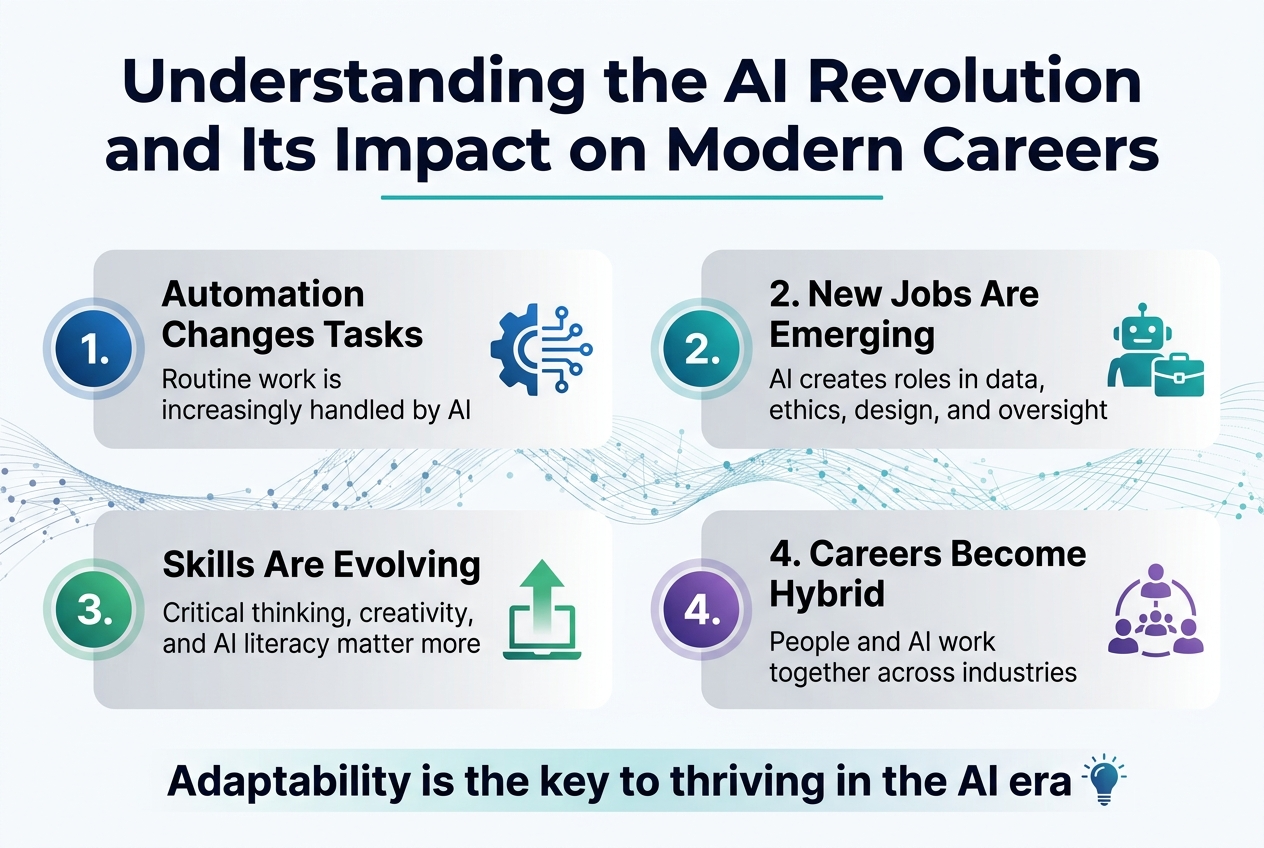
Understanding the AI Revolution and Its Impact on Modern Careers
Defining Autonomous AI Agents and Their Current Capabilities
Autonomous AI agents represent a significant leap from traditional automation tools. These systems can analyze data, make decisions, and execute complex tasks with minimal human oversight. Unlike simple chatbots or basic automation software, these agents learn from patterns, adapt to new situations, and handle multi-step processes independently.
Today’s autonomous AI agents excel in several key areas. They process vast amounts of information faster than any human team could manage. Natural language processing allows them to understand context, nuance, and even emotional undertones in communication. Computer vision enables them to analyze images, videos, and visual data with remarkable accuracy. Machine learning algorithms help them improve their performance over time without explicit programming.
Current capabilities include writing sophisticated content, analyzing financial markets, diagnosing medical conditions from imaging data, and managing supply chain logistics. These systems can work 24/7 without breaks, maintain consistent quality standards, and handle routine tasks that previously required human attention.
However, these agents still struggle with creative problem-solving that requires genuine innovation, emotional intelligence in complex interpersonal situations, and tasks requiring physical dexterity in unpredictable environments. They also lack the ability to make ethical judgments in ambiguous situations or understand cultural nuances that haven’t been explicitly programmed.
Industries Experiencing the Most Dramatic AI Transformation
The financial services sector leads the charge in AI adoption. Banks use autonomous agents for fraud detection, algorithmic trading, risk assessment, and customer service. Investment firms rely on AI for portfolio management and market analysis. Insurance companies automate claims processing and underwriting decisions.
Healthcare has seen revolutionary changes through AI-powered diagnostic tools, drug discovery platforms, and personalized treatment recommendations. Radiology departments now use AI to detect anomalies in medical imaging, while pharmaceutical companies accelerate research timelines using machine learning algorithms.
Manufacturing and logistics industries have embraced AI for predictive maintenance, quality control, and supply chain optimization. Autonomous vehicles and drones are transforming transportation and delivery services. Warehouses operate with AI-driven inventory management and robotic fulfillment systems.
Customer service across all industries has been transformed by sophisticated chatbots and virtual assistants that handle complex inquiries, troubleshoot problems, and escalate issues appropriately. Marketing departments leverage AI for personalized content creation, targeted advertising, and customer behavior analysis.
Jobs at Highest Risk of Automation Versus Those Gaining Value
Jobs facing the highest automation risk typically involve repetitive, rule-based tasks or data processing. Data entry clerks, basic bookkeepers, routine customer service representatives, and assembly line workers are seeing their roles increasingly automated. Travel agents, cashiers, and junior financial analysts also face significant displacement as AI systems handle these functions more efficiently.
| High Automation Risk | Low Automation Risk |
|---|---|
| Data Entry Clerks | Creative Directors |
| Basic Bookkeepers | Mental Health Counselors |
| Routine Customer Service | Strategic Consultants |
| Assembly Line Workers | Research Scientists |
| Junior Financial Analysts | Project Managers |
| Travel Agents | Skilled Trades Workers |
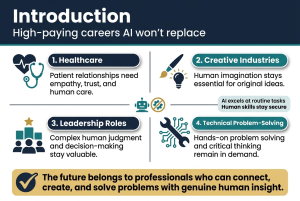
Jobs gaining value require uniquely human skills that complement AI capabilities. Creative professionals who can work with AI tools to enhance their output are in high demand. Mental health professionals, teachers, and coaches leverage human emotional intelligence that AI cannot replicate. Strategic roles requiring complex decision-making, relationship building, and cultural understanding remain firmly in human hands.
Technical roles focused on AI development, implementation, and maintenance are experiencing explosive growth. AI trainers, prompt engineers, and machine learning specialists represent entirely new career categories. Project managers who can coordinate human-AI collaboration are increasingly valuable.
The Shift from Human-versus-AI to Human-with-AI Mindset
The competitive landscape has evolved beyond viewing AI as a threat to embracing it as a powerful collaborator. Successful professionals now focus on developing AI collaboration skills rather than competing against machines. This mindset shift recognizes that the most effective outcomes emerge from combining human creativity, emotional intelligence, and strategic thinking with AI’s computational power and analytical capabilities.
Smart professionals identify tasks where AI excels and delegate accordingly, while focusing their energy on activities that require uniquely human skills. A marketing professional might use AI to analyze customer data and generate initial content drafts, then apply human insight to craft compelling narratives and build authentic relationships.
This collaborative approach creates compound value. Human intuition guides AI analysis toward meaningful insights. AI processing power enables humans to explore more possibilities and test ideas faster. The result is output that neither humans nor AI could achieve independently.
Organizations increasingly value employees who can effectively bridge the human-AI gap, translating business needs into AI solutions and interpreting AI outputs for strategic decision-making. This represents a fundamental shift in how we think about career development in an AI-driven workplace.
Identifying Your Unique Human Advantages in an AI-Driven World
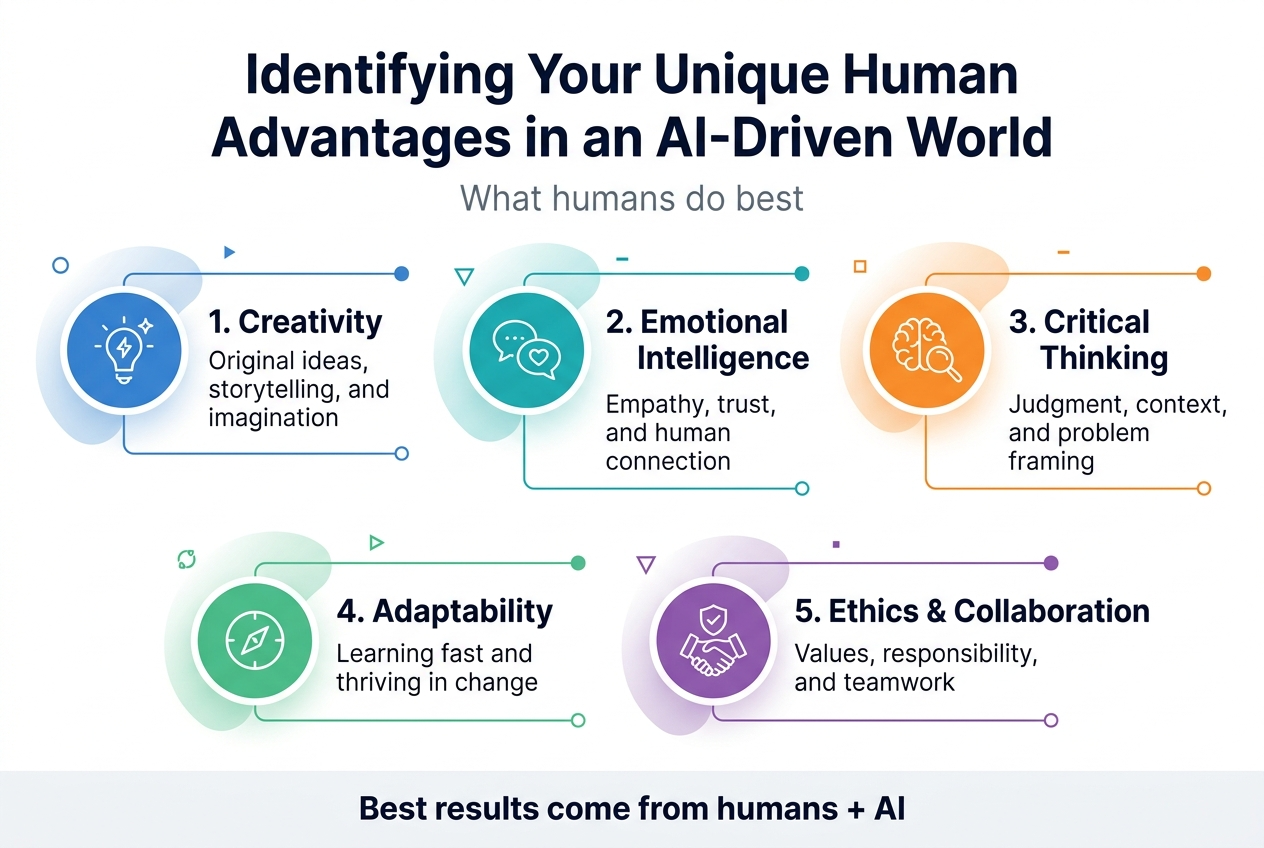
Emotional Intelligence and Interpersonal Skills That AI Cannot Replicate
Your ability to read between the lines, pick up on subtle emotional cues, and navigate complex social dynamics remains uniquely human. While autonomous AI agents excel at processing data and following algorithms, they can’t truly understand the nervous laugh of a colleague under pressure or sense when a team member needs encouragement rather than feedback.
Emotional intelligence encompasses your capacity to recognize, understand, and manage emotions—both your own and others’. This includes empathy, social awareness, and the ability to adapt your communication style based on the emotional state of those around you. In an AI-driven workplace, these skills become even more valuable as human interactions require increasingly sophisticated emotional navigation.
Consider how you naturally adjust your approach when delivering difficult news to different personality types, or how you can sense team morale shifting during a challenging project. These intuitive responses stem from years of human experience and emotional learning that AI simply cannot replicate authentically.
Creative Problem-Solving and Innovative Thinking Capabilities
Your brain’s ability to make unexpected connections, challenge assumptions, and think outside established patterns gives you a significant edge over even the most advanced AI systems. While AI excels at finding optimal solutions within defined parameters, human creativity thrives in ambiguity and uncertainty.
Creative problem-solving involves several uniquely human traits:
- Lateral thinking: Making connections between seemingly unrelated concepts
- Intuitive leaps: Drawing insights from incomplete information
- Contextual innovation: Understanding cultural, social, and business nuances that inform creative solutions
- Risk-taking creativity: Pursuing unconventional ideas that might fail but could lead to breakthrough innovations
Your personal experiences, cultural background, and unique perspective shape how you approach problems. This diversity of thought and experience creates solutions that AI, despite its computational power, cannot generate through pure logic and pattern recognition.
Ethical Reasoning and Moral Decision-Making Abilities
As AI systems become more prevalent in decision-making processes, the need for human ethical oversight becomes critical. Your ability to consider moral implications, weigh competing values, and make judgment calls in gray areas represents an irreplaceable human advantage.
Ethical reasoning involves understanding context, considering stakeholders, and applying moral frameworks that go beyond simple rule-following. You can evaluate the broader impact of decisions on communities, consider long-term consequences, and balance competing interests in ways that require genuine moral reasoning.
Key aspects of human ethical decision-making include:
| Human Ethical Strength | Why AI Falls Short |
|---|---|
| Cultural sensitivity | Cannot truly understand cultural nuances and values |
| Moral intuition | Lacks genuine emotional and moral understanding |
| Stakeholder empathy | Cannot feel genuine concern for human welfare |
| Contextual judgment | Struggles with complex moral trade-offs |
Complex Communication and Relationship-Building Strengths
Your ability to build trust, establish rapport, and communicate complex ideas through storytelling and persuasion remains distinctly human. While AI can process language and generate responses, it cannot form genuine relationships or understand the subtle art of human communication.
Relationship-building involves patience, consistency, vulnerability, and the ability to show genuine care for others’ success and well-being. These qualities enable you to motivate teams, negotiate complex deals, mentor colleagues, and create the kind of collaborative environments where innovation flourishes.
Your communication strengths extend beyond just exchanging information. You can inspire, comfort, challenge, and connect with people in ways that create lasting professional relationships. You understand when to push and when to support, when to be direct and when to be diplomatic.
In the age of human-AI collaboration, these relationship-building skills become even more valuable as teams become increasingly diverse, including both human and AI elements. Your ability to bridge different communication styles, facilitate understanding between team members, and create inclusive environments where everyone—human and AI—can contribute effectively becomes a crucial career asset.
The combination of these uniquely human advantages creates a powerful foundation for future-proof career development. By recognizing and strengthening these capabilities, you position yourself not as competition for AI, but as an essential complement to AI systems in the modern workplace.
Building Essential AI Collaboration Skills
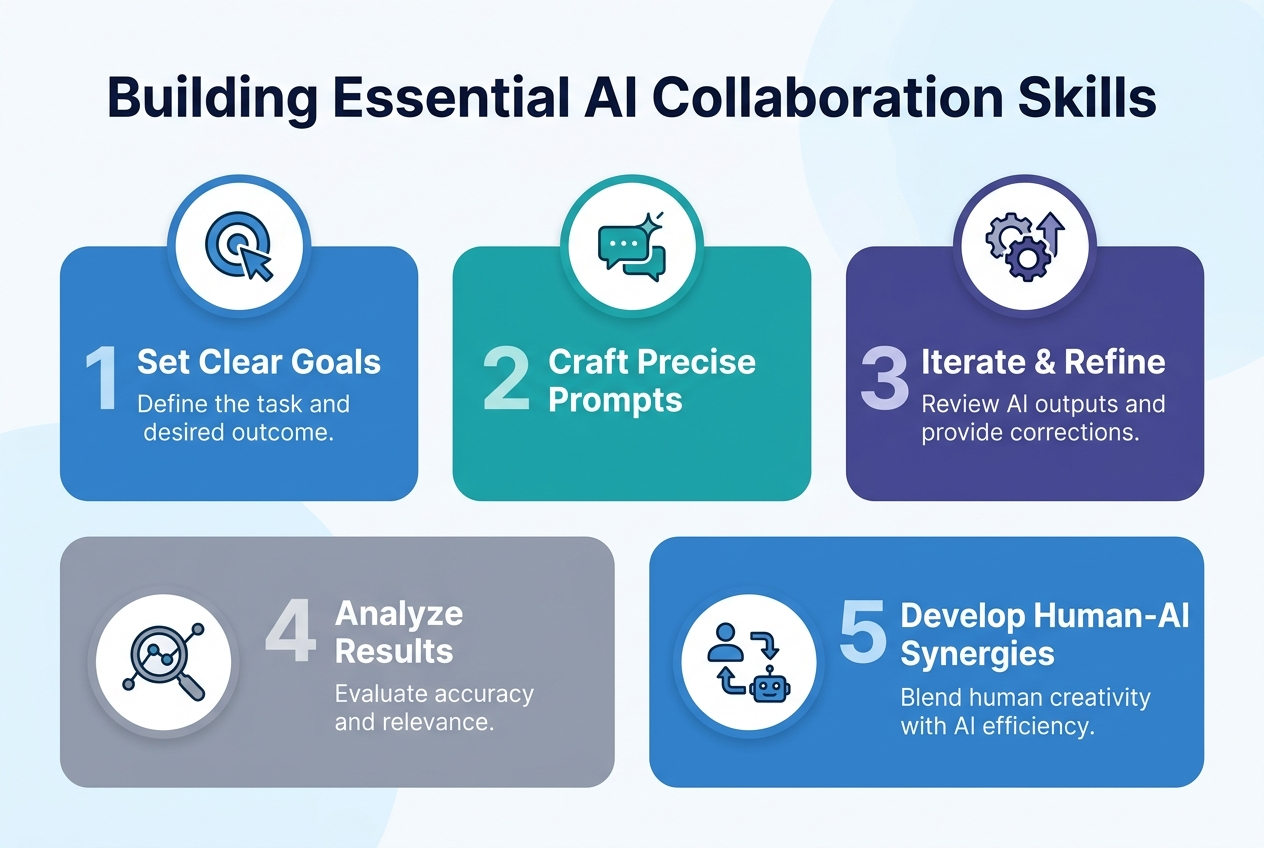
Learning to Prompt and Communicate Effectively with AI Systems
The backbone of successful human-AI collaboration lies in mastering the art of AI communication. Think of prompting as learning a new language – one where precision meets creativity. Effective prompting goes beyond simply typing commands; it requires understanding how AI systems process information and respond to different communication styles.
Start by developing structured prompting techniques. Break complex tasks into smaller, specific requests rather than overwhelming the AI with lengthy, multi-layered instructions. For example, instead of asking “Help me create a marketing strategy for my business,” try “Generate three target audience segments for a sustainable clothing brand targeting millennials in urban areas.” This approach yields more actionable and relevant results.
Context setting becomes your secret weapon in AI collaboration skills. Always provide relevant background information, specify your desired output format, and clarify your intended use case. AI systems perform exponentially better when they understand the “why” behind your request, not just the “what.”
Experiment with different prompting styles to find what works best for various AI tools. Some systems respond better to conversational language, while others prefer structured, bullet-point instructions. Keep a personal prompting library of effective templates that you can adapt for different situations and tools.
Developing AI Literacy and Understanding System Limitations
True AI literacy means recognizing both the incredible capabilities and inherent limitations of autonomous AI agents. This knowledge forms the foundation for realistic expectations and effective collaboration strategies in the AI-driven workplace.
Start by understanding the training data limitations that affect AI outputs. Most AI systems have knowledge cutoff dates and may lack information about recent events or specialized niche topics. They also struggle with tasks requiring real-world experience, emotional intelligence, or cultural nuance that comes naturally to humans.
Recognize pattern recognition vs. true understanding. While AI excels at identifying patterns in data and generating responses based on those patterns, it doesn’t possess genuine comprehension or consciousness. This distinction helps you assign appropriate tasks and maintain realistic expectations about AI capabilities.
Stay informed about different AI model types and their specific strengths. Large language models excel at text generation and analysis, while computer vision models handle image processing, and specialized AI tools focus on particular industries or functions. Understanding these differences helps you choose the right tool for each task.
Create a personal AI capability map that outlines what different AI tools can and cannot do reliably. This living document should include:
| AI Capability | Strength Level | Best Use Cases | Known Limitations |
|---|---|---|---|
| Text Generation | High | Content drafting, ideation | Factual accuracy, recent events |
| Data Analysis | Very High | Pattern identification, summarization | Context interpretation |
| Creative Tasks | Moderate | Brainstorming, design concepts | Original innovation, brand consistency |
| Research | Moderate | Information gathering | Source verification, bias detection |
Mastering the Art of Human Oversight and Quality Control
Human oversight transforms AI from a potentially unreliable tool into a powerful collaborative partner. Your role as the human in the loop involves strategic quality control that leverages your unique judgment capabilities.
Develop systematic verification processes for AI outputs. Create checklists that cover accuracy, relevance, tone consistency, and alignment with your objectives. For content creation, this might include fact-checking claims, ensuring brand voice consistency, and verifying that the output serves your intended purpose.
Learn to spot common AI pitfalls before they become problems. AI systems often produce confident-sounding but incorrect information, struggle with logical contradictions, and may generate biased or inappropriate content. Train yourself to recognize these red flags through practice and experience.
Build feedback loops that improve your AI collaboration over time. Document what works and what doesn’t, noting patterns in AI performance across different types of tasks. This creates a valuable knowledge base for future interactions and helps you refine your prompting and oversight techniques.
Establish clear boundaries for AI autonomy in your workflow. Determine which tasks require minimal oversight, which need moderate review, and which demand extensive human validation. High-stakes communications, creative brand work, and strategic decisions typically require maximum human involvement, while data formatting and initial research drafts may need less intensive oversight.
Practice the “trust but verify” approach that defines effective human-AI collaboration. Use AI to accelerate your work and expand your capabilities, but maintain your role as the final decision-maker and quality gatekeeper. This balanced approach allows you to harness AI’s efficiency while preserving the critical thinking and contextual awareness that only humans provide.
Strategic Career Pivoting for Long-Term Relevance
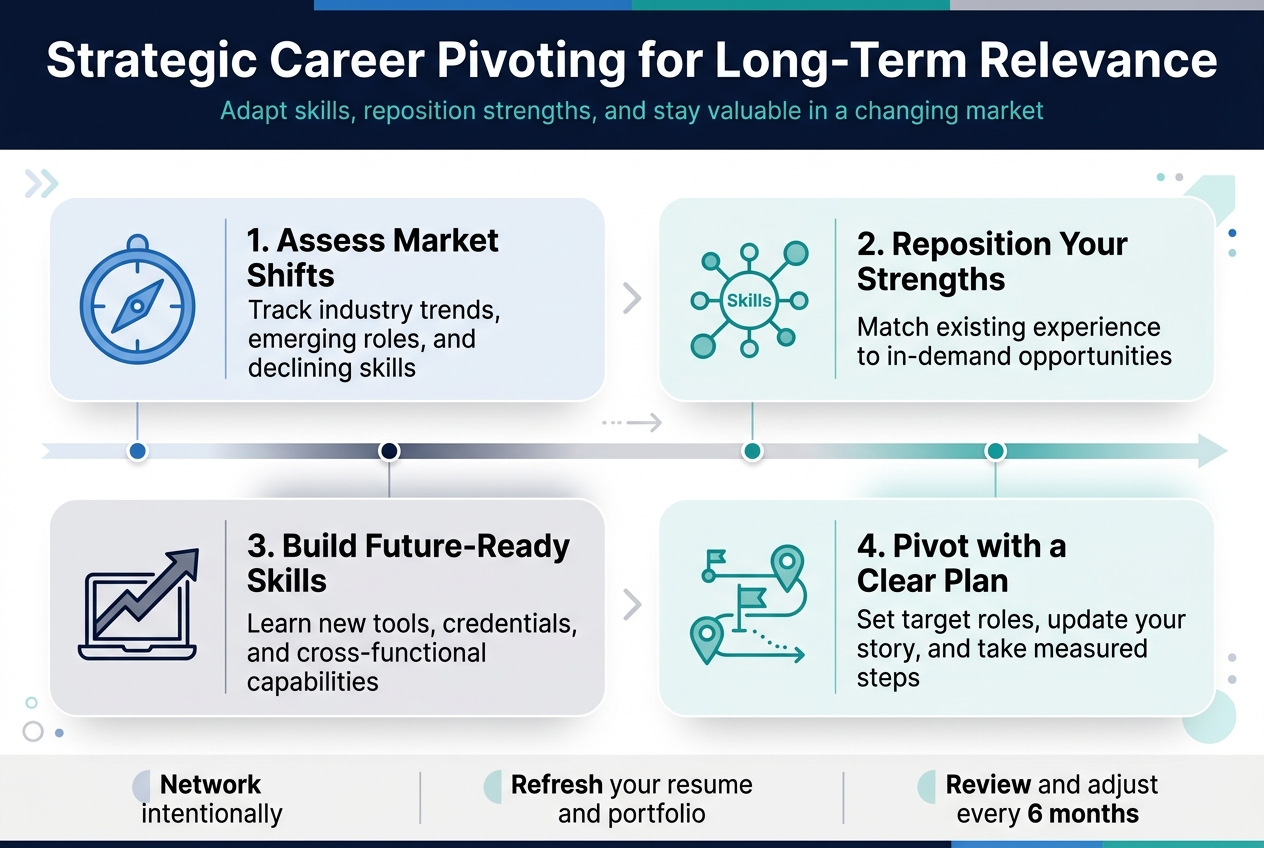
Identifying Emerging Roles That Combine Human Expertise with AI Capabilities
The job market is transforming rapidly as autonomous AI agents become more sophisticated. Rather than replacing humans entirely, the most promising career opportunities are emerging at the intersection of human insight and AI capability. These AI-driven workplace roles require professionals who can bridge the gap between technical innovation and human understanding.
Consider the role of AI trainers and prompt engineers – professionals who teach AI systems to understand context, nuance, and industry-specific requirements. These positions demand deep subject matter expertise combined with the ability to communicate effectively with AI systems. Healthcare AI coordinators work alongside doctors to ensure AI diagnostic tools provide accurate, contextually appropriate recommendations while maintaining the human touch patients need.
Customer experience specialists are evolving into AI-human interaction designers, crafting seamless experiences where AI handles routine inquiries while humans manage complex emotional situations. Data storytellers combine AI’s analytical power with human creativity to translate complex insights into compelling narratives that drive business decisions.
Developing Skills That Complement Rather Than Compete with AI
Smart career development in AI age focuses on amplifying your uniquely human abilities rather than trying to outperform machines at computational tasks. Emotional intelligence becomes your competitive edge – AI can process data, but it can’t genuinely empathize with a frustrated customer or navigate office politics with finesse.
Critical thinking and creative problem-solving represent areas where humans still excel. While AI can generate solutions based on patterns, humans bring intuition, ethical reasoning, and the ability to think outside established frameworks. Developing these skills means practicing scenario analysis, questioning assumptions, and approaching problems from multiple angles.
AI collaboration skills include learning to ask the right questions, understanding AI limitations, and knowing when to override AI recommendations. This requires developing a healthy skepticism toward automated outputs while appreciating their value. Practice interpreting AI-generated reports, identifying potential biases, and translating technical outputs into actionable business strategies.
Communication skills become even more valuable in an AI-augmented workplace. You need to explain AI decisions to stakeholders, facilitate conversations between technical and non-technical teams, and help colleagues feel comfortable working alongside intelligent systems.
Building a Personal Brand Around Human-AI Collaboration
Your professional brand should position you as someone who maximizes human-AI collaboration rather than someone who merely uses AI tools. This distinction matters because it demonstrates strategic thinking about technology integration rather than basic technical competency.
Share case studies of successful AI implementations you’ve led or contributed to, emphasizing the human judgment calls that made the difference. Write about the ethical considerations in AI deployment, the importance of maintaining human oversight, and how you’ve helped teams adapt to AI-augmented workflows.
Document your journey learning to work with AI systems. Create content about the challenges you’ve faced, the lessons you’ve learned, and the frameworks you’ve developed for effective collaboration. This transparency builds credibility and helps others navigate similar transitions.
Engage in conversations about the future of work, but avoid both extreme AI pessimism and blind techno-optimism. Position yourself as a balanced voice who understands both the opportunities and challenges of working with artificial intelligence.
Creating Multiple Income Streams Through AI-Enhanced Work
Diversifying your income through AI-enhanced services provides both financial security and valuable experience with different AI applications. Freelance consultants are using AI to accelerate research, create more comprehensive proposals, and deliver higher-quality work in less time, allowing them to take on more clients profitably.
Many professionals are developing AI-enhanced courses or coaching services, using AI to personalize content delivery while providing human guidance and accountability. Creative professionals combine AI-generated concepts with human refinement, offering clients faster turnaround times at competitive prices while maintaining quality standards.
Consider developing products that showcase effective human-AI partnerships. This might include AI-assisted market research services, content creation workflows that combine AI efficiency with human creativity, or consulting services that help other businesses implement AI solutions thoughtfully.
The key is positioning AI as your accelerator rather than your replacement. Your clients pay for your judgment, experience, and ability to synthesize AI outputs into actionable strategies.
Networking Strategies for the AI-Augmented Professional Landscape
Career pivoting strategies require building relationships with professionals who are successfully navigating the AI transition. Attend AI conferences not just to learn about technology, but to connect with practitioners who are applying AI in your industry.
Join communities focused on ethical AI implementation, where discussions center on responsible deployment rather than just technical capabilities. These groups attract thoughtful professionals who understand the nuances of human-AI collaboration.
Seek mentorship from professionals who’ve successfully integrated AI into their workflows without losing their human edge. Learn from their mistakes, understand their decision-making frameworks, and adapt their strategies to your situation.
Build relationships with AI researchers and developers to stay informed about emerging capabilities before they become mainstream. This early insight allows you to prepare for new opportunities and position yourself as an early adopter when new tools become available.
Remember that networking in the AI age isn’t just about meeting people – it’s about building relationships that help you stay adaptable as technology evolves. Focus on connecting with professionals who share your commitment to thoughtful, human-centered AI implementation.
Practical Steps to Start Your AI Integration Journey Today
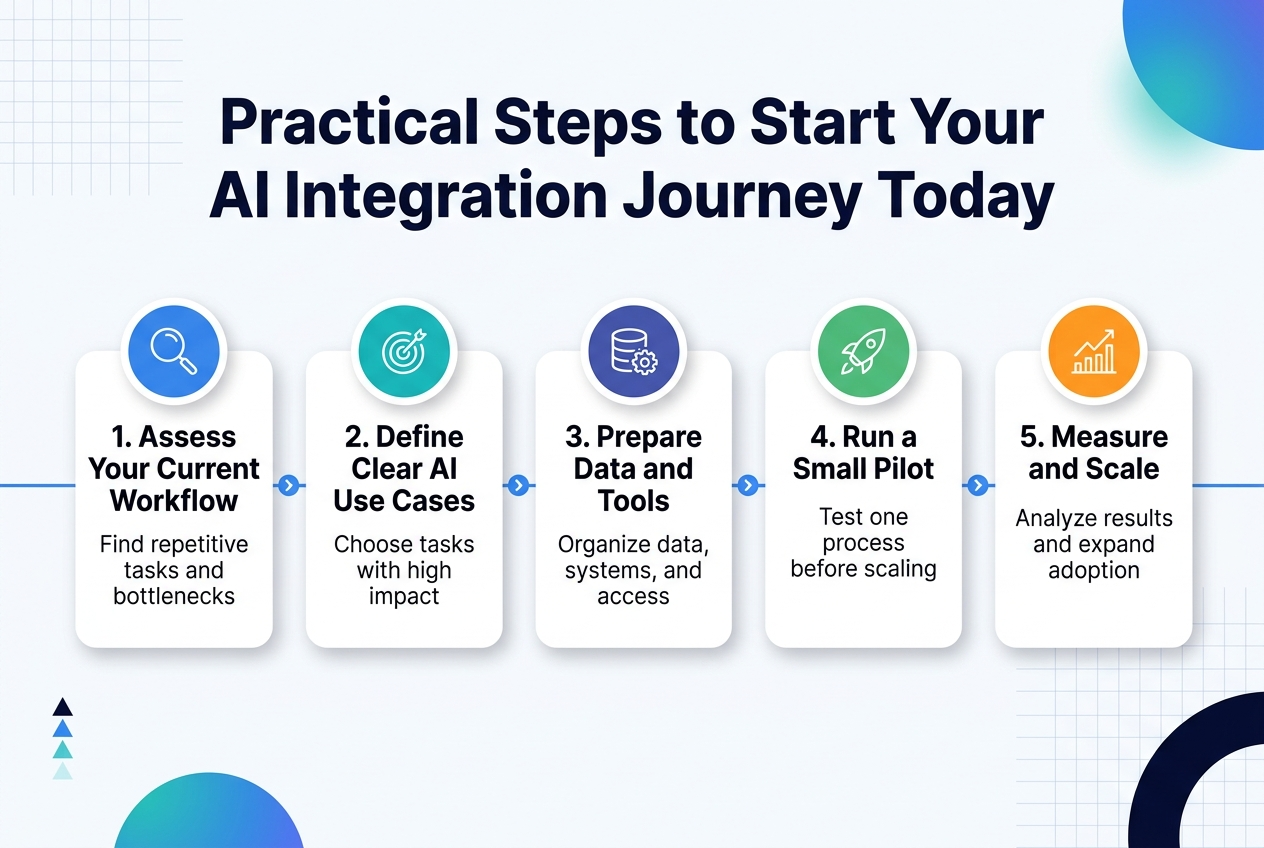
Free and Low-Cost AI Tools to Experiment With in Your Current Role
Getting started with AI integration skills doesn’t require a massive budget or approval from upper management. Plenty of accessible tools can transform how you work right now, giving you hands-on experience with human-AI collaboration.
ChatGPT and Claude serve as excellent starting points for text-related tasks. Use them to draft emails, brainstorm ideas, or refine presentations. Marketing professionals can generate social media content variations, while project managers can create meeting agendas or stakeholder communications. The key is treating these tools as writing partners, not replacements.
Canva’s AI features revolutionize visual content creation. The Magic Design tool generates presentations, social posts, and marketing materials based on simple prompts. Even non-designers can produce professional-quality graphics by collaborating with AI to iterate and refine concepts.
Notion AI transforms note-taking and project management. It can summarize meeting notes, create action items from brainstorming sessions, or generate project timelines. Sales teams use it to craft personalized outreach messages, while HR professionals create job descriptions and training materials.
Google’s AI tools integrate seamlessly into existing workflows. Gmail’s Smart Compose and Smart Reply features speed up email communication, while Google Sheets’ AI insights help analyze data patterns. Google Slides’ auto-generated speaker notes assist with presentation preparation.
Grammarly and Hemingway Editor enhance writing quality through AI-powered suggestions. These tools catch grammar errors, improve clarity, and adjust tone for different audiences. Content creators and business professionals alike benefit from these collaborative editing partners.
For data analysis, Microsoft Excel’s AI features or Google Analytics Intelligence provide natural language queries and automated insights. You can ask questions about your data in plain English and receive visualizations and trend analyses.
Calendly’s AI scheduling assistant and Zoom’s AI Companion streamline administrative tasks. They handle meeting coordination, generate summaries, and create action items, freeing up time for higher-value work.
Start small with one tool that directly addresses a current pain point in your workflow. Spend 15-30 minutes daily experimenting with different prompts and approaches. Document what works well and what doesn’t to build your AI collaboration skills systematically.
Online Courses and Certifications for AI Collaboration Skills
Formal education in AI-driven workplace skills provides structured learning paths and credible credentials that employers recognize.
Coursera’s AI for Everyone by Andrew Ng offers a non-technical introduction to artificial intelligence concepts. This course helps professionals understand AI capabilities and limitations without requiring programming knowledge. The focus on business applications makes it perfect for career development in AI age.
edX’s Introduction to Artificial Intelligence from MIT provides deeper technical understanding while remaining accessible to non-engineers. You’ll learn about machine learning fundamentals, natural language processing, and computer vision applications relevant to various industries.
LinkedIn Learning’s AI courses cover practical applications like “AI in Marketing,” “AI for Project Management,” and “Ethics in AI.” These micro-courses take 2-3 hours each and provide immediately applicable skills. The platform’s integration with professional profiles makes completed courses visible to potential employers.
Udacity’s AI Product Manager Nanodegree targets professionals who want to bridge technical and business teams. This program teaches how to evaluate AI opportunities, manage AI projects, and communicate with technical teams effectively.
Google’s AI for Everyone Professional Certificate on Coursera covers AI applications across different business functions. The hands-on projects involve real AI tools and scenarios, building practical experience alongside theoretical knowledge.
IBM’s Applied AI Professional Certificate focuses on practical implementation rather than theory. Students work with IBM Watson and other enterprise AI tools, learning to build chatbots, analyze sentiment, and process natural language data.
Microsoft’s AI Business School offers free case studies and implementation guides. While not a traditional certification program, it provides real-world examples of successful AI integration across industries.
Stanford’s Human-Computer Interaction courses available through online platforms teach crucial skills for designing effective human-AI collaboration systems. These courses blend psychology, design thinking, and technology understanding.
Consider your current role and career goals when selecting courses. Sales professionals might prioritize AI in customer relationship management, while operations managers could focus on process optimization and predictive analytics courses.
Many programs offer financial aid or employer sponsorship options. Some companies reimburse course fees as professional development expenses, making advanced certifications more accessible.
Building a Portfolio of Human-AI Collaborative Projects
Creating tangible examples of working with artificial intelligence demonstrates your capabilities to current employers and future opportunities. A strong portfolio showcases both technical competence and strategic thinking about AI integration.
Start by documenting current AI tool usage in your daily work. Screenshot before-and-after examples of content you’ve improved with AI assistance. Show email drafts that AI helped refine, presentations enhanced with AI-generated graphics, or reports that benefited from AI-powered data analysis.
Project documentation should highlight your role as the human collaborator. Explain your prompting strategies, how you evaluated AI outputs, and what modifications you made. This demonstrates critical thinking and quality control skills that employers value in AI collaboration skills.
Create case studies around specific challenges you’ve solved through human-AI partnership. For example, a marketing professional might document how they used AI to personalize email campaigns while maintaining brand voice and authenticity. Include metrics like open rates, response times, or cost savings to quantify impact.
Cross-functional collaboration projects showcase leadership in AI adoption. Propose pilot programs where you introduce AI tools to team workflows. Document the implementation process, training you provided to colleagues, and results achieved. This positions you as an AI integration leader rather than just a user.
Develop comparative analyses showing traditional approaches versus AI-enhanced methods. Time studies, quality assessments, and efficiency measurements provide concrete evidence of AI’s value when guided by human expertise.
Industry-specific applications make your portfolio more relevant to target roles. Healthcare professionals might focus on AI-assisted patient communication, while financial analysts could highlight AI-enhanced market research projects.
Share your projects through professional networks. Write LinkedIn articles about successful AI implementations, present at industry conferences, or contribute to professional forums. This visibility establishes your reputation as someone skilled in future-proof career development.
Include failed experiments alongside successes. Honest assessments of what didn’t work and lessons learned demonstrate maturity and continuous learning mindset. Employers appreciate professionals who can navigate AI limitations intelligently.
Create video demonstrations where possible. Screen recordings of your AI collaboration process, from initial prompts through final outputs, provide compelling evidence of your practical skills. These visual portfolios often resonate more strongly than written case studies alone.
Regular portfolio updates reflect ongoing learning and adaptation. Set quarterly reviews to add new projects, refine existing case studies, and remove outdated examples. This maintenance ensures your portfolio accurately represents current capabilities and industry trends.
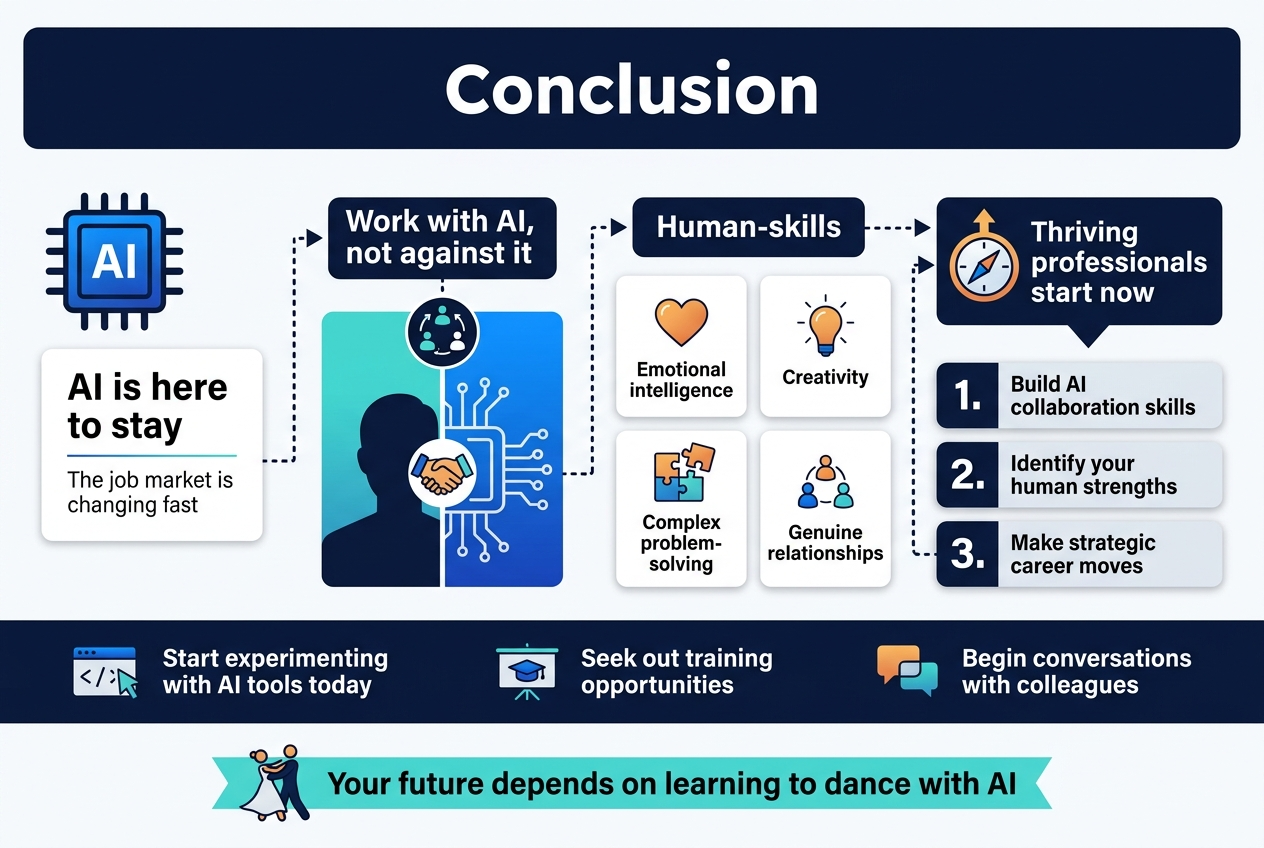
The job market is changing fast, and AI isn’t going anywhere. But instead of viewing this shift as a threat, smart professionals are learning to work alongside these powerful tools to amplify their own capabilities. Your emotional intelligence, creativity, complex problem-solving skills, and ability to build genuine relationships remain uniquely human – and they’re exactly what companies need most as they navigate this new landscape.
The professionals who will thrive are those who start building their AI collaboration skills now, identify where their human strengths shine brightest, and make strategic career moves that position them as indispensable partners to AI systems. Don’t wait for the perfect moment or for your industry to force your hand. Start experimenting with AI tools today, seek out training opportunities, and begin conversations with colleagues about how you can work together to leverage these technologies. Your career’s future depends not on competing with AI, but on learning to dance with it.