

AI agents are changing how businesses operate, and the shift is happening faster than most leaders expected. These autonomous technology systems can handle everything from customer service to complex data analysis without constant human oversight.
This guide is for business owners, executives, and decision-makers who want to understand how AI-driven solutions can transform their operations. You don’t need a tech background – just a willingness to explore how artificial intelligence for business can work for your company.
We’ll cover how AI agents actually function in real business settings and what applications make the most sense for different industries. You’ll learn practical strategies for implementing intelligent automation to boost productivity while cutting operational costs. Finally, we’ll walk through the common challenges companies face during AI implementation and how to set up your business for long-term success with autonomous AI systems.
The businesses that adapt to this technology now will have a significant advantage over those that wait.
Understanding AI Agents and Their Business Applications
Defining AI Agents and Their Core Capabilities
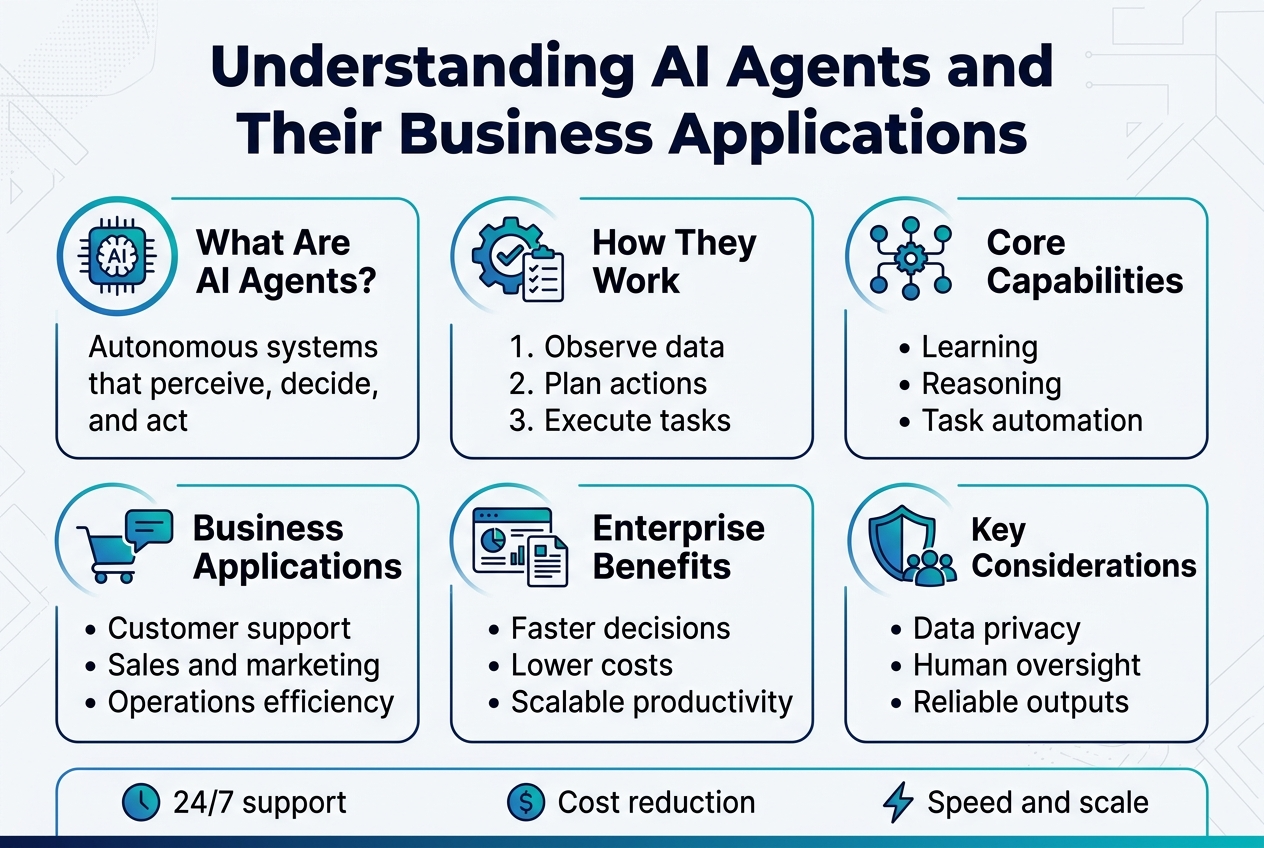
AI agents represent a revolutionary leap in autonomous technology, functioning as digital entities that can perceive their environment, make decisions, and take actions to achieve specific goals without constant human supervision. Unlike static software programs, these intelligent systems continuously learn from data, adapt to changing conditions, and execute complex tasks across multiple business functions.
The core capabilities of AI agents include natural language processing for seamless communication, machine learning algorithms for pattern recognition and prediction, and decision-making frameworks that evaluate options and select optimal courses of action. These systems can process vast amounts of structured and unstructured data in real-time, enabling them to respond to market changes, customer inquiries, and operational challenges with speed and precision that surpasses human capacity.
Modern AI agents excel at multi-modal interactions, combining text, voice, visual, and sensor data to build comprehensive situational awareness. They can manage complex workflows, coordinate with other systems, and even negotiate on behalf of their organizations. Advanced agents incorporate reasoning capabilities that allow them to break down complex problems into manageable components and develop strategic solutions.
Key Differences Between AI Agents and Traditional Automation
Traditional automation follows rigid, pre-programmed rules and requires explicit instructions for every possible scenario. These systems excel at repetitive, rule-based tasks but struggle when faced with unexpected situations or the need for creative problem-solving. Business automation through traditional methods typically involves creating fixed workflows that execute the same sequence of actions regardless of context.
AI agents, however, bring adaptive intelligence to automated business processes. They can handle ambiguous situations, learn from experience, and modify their behavior based on new information. While traditional automation might stop when encountering an unforeseen scenario, intelligent automation powered by AI agents can analyze the situation, reference similar past experiences, and develop appropriate responses.
The learning capability sets AI agents apart dramatically. Traditional systems require manual updates and reprogramming to accommodate changes, while AI-driven solutions continuously improve their performance through machine learning algorithms. This self-improving nature means that AI agents become more valuable over time, developing deeper expertise in their assigned domains.
Current Real-World Examples of AI Agents in Business
Customer service represents one of the most visible applications of AI agents in business today. Companies like Shopify and Zendesk deploy sophisticated chatbots that handle multiple customer inquiries simultaneously, escalating complex issues to human agents while resolving routine questions instantly. These systems access customer history, product databases, and company policies to provide personalized, accurate responses.
Financial institutions leverage AI agents for fraud detection and prevention, with systems that monitor millions of transactions in real-time, identifying suspicious patterns and automatically blocking potentially fraudulent activities. JPMorgan Chase’s COIN system processes legal documents and contracts, extracting key information and identifying potential risks faster than teams of lawyers.
Supply chain management has been transformed by AI agents that optimize inventory levels, predict demand fluctuations, and coordinate logistics across global networks. Amazon’s fulfillment centers rely on AI agents to manage warehouse operations, from predicting which products to stock in specific locations to coordinating robot movements for maximum efficiency.
Sales and marketing departments increasingly depend on AI agents for lead qualification, personalized content creation, and campaign optimization. These systems analyze customer behavior patterns, predict purchasing likelihood, and automatically adjust marketing strategies to maximize conversion rates.
The Technology Stack Powering Autonomous Business Systems
The foundation of AI productivity tools rests on several interconnected technological layers. Machine learning frameworks like TensorFlow and PyTorch provide the computational engines that enable pattern recognition and predictive analytics. Cloud computing platforms offer the scalable infrastructure necessary to process massive datasets and run complex algorithms.
Natural language processing engines, including large language models, enable AI agents to understand and generate human-like text, making them effective communicators in business contexts. Computer vision systems allow agents to process visual information, from analyzing documents to monitoring video feeds for quality control.
Data integration platforms serve as the nervous system of autonomous AI systems, connecting disparate business applications and ensuring AI agents have access to real-time information across the organization. APIs and microservices architecture enable seamless communication between AI agents and existing business software, creating cohesive digital ecosystems.
Edge computing capabilities bring processing power closer to data sources, reducing latency and enabling real-time decision-making in time-critical applications. Blockchain technology provides secure, transparent record-keeping for AI agent actions, creating audit trails and enabling trust in automated decisions.
Transform Your Operations with Intelligent Automation
Streamlining Customer Service Through 24/7 AI Support
AI agents are completely changing how businesses handle customer support. These intelligent systems can chat with customers around the clock, answering questions and solving problems without needing breaks or vacations. Unlike traditional chatbots that follow rigid scripts, modern AI agents understand context and can handle complex conversations that feel natural.
Key capabilities of AI-powered customer service:
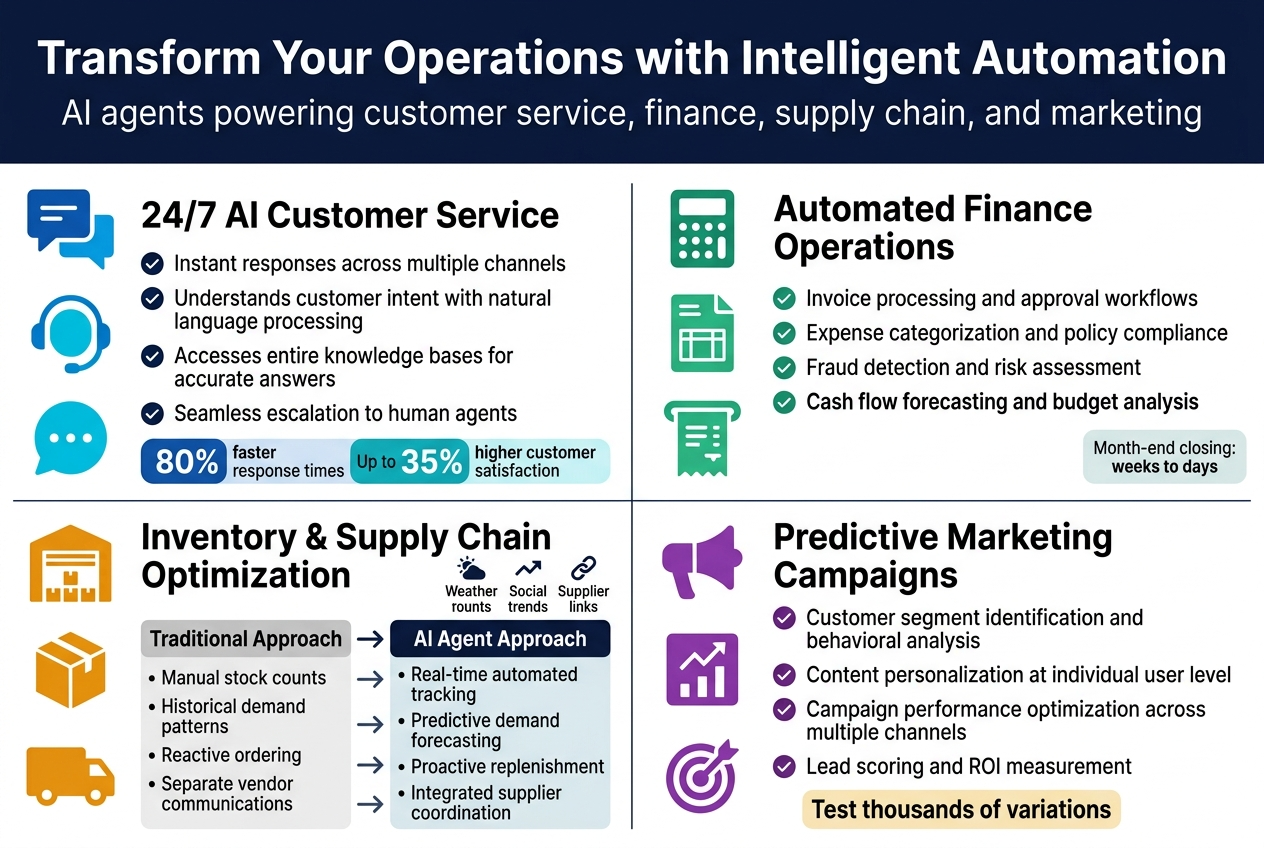
- Instant responses to customer inquiries across multiple channels
- Natural language processing that understands customer intent
- Access to entire knowledge bases for accurate information delivery
- Seamless escalation to human agents when needed
- Multi-language support for global customer bases
Companies using AI agents for customer service report average response time reductions of 80% and customer satisfaction improvements of up to 35%. These systems learn from every interaction, becoming smarter and more helpful over time. They can handle routine tasks like order tracking, return processing, and basic troubleshooting, freeing up human agents to focus on complex issues that require empathy and creative problem-solving.
Automating Financial Processes and Expense Management
Financial departments are experiencing massive transformation through intelligent automation. AI agents can process invoices, manage expense reports, and handle routine accounting tasks with incredible accuracy. These systems catch errors that humans might miss while processing transactions at superhuman speeds.
Core areas where AI agents excel in finance:
- Invoice processing and approval workflows
- Expense categorization and policy compliance
- Fraud detection and risk assessment
- Cash flow forecasting and budget analysis
- Regulatory compliance monitoring
Smart expense management systems can automatically scan receipts, categorize expenses, and flag potential policy violations. They integrate with banking systems to reconcile transactions in real-time, dramatically reducing month-end closing times from weeks to days. AI-driven solutions also provide predictive insights about spending patterns and budget variances, helping finance teams make proactive decisions rather than reactive ones.
Revolutionizing Inventory Management and Supply Chain Optimization
Supply chain management becomes incredibly powerful when AI agents take control of inventory decisions. These systems analyze thousands of variables simultaneously – from weather patterns affecting shipping to social media trends predicting demand spikes. They optimize stock levels, predict maintenance needs, and coordinate with suppliers automatically.
Revolutionary changes in inventory management:
| Traditional Approach | AI Agent Approach |
|---|---|
| Manual stock counts | Real-time automated tracking |
| Historical demand patterns | Predictive demand forecasting |
| Reactive ordering | Proactive replenishment |
| Separate vendor communications | Integrated supplier coordination |
AI agents monitor supplier performance, track delivery times, and can automatically switch to backup suppliers when disruptions occur. They prevent both stockouts and overstock situations by continuously analyzing sales patterns, seasonal trends, and external factors. Some systems even negotiate prices with suppliers based on market conditions and order volumes.
Enhancing Marketing Campaigns with Predictive Analytics
Marketing teams are leveraging AI agents to create hyper-personalized campaigns that deliver the right message to the right person at the perfect moment. These autonomous systems analyze customer behavior, predict purchase intentions, and optimize marketing spend across channels in real-time.
Advanced marketing automation capabilities:
- Customer segment identification and behavioral analysis
- Content personalization at individual user level
- Campaign performance optimization across multiple channels
- Lead scoring and sales funnel management
- Attribution modeling and ROI measurement
AI-driven marketing platforms can test thousands of ad variations simultaneously, automatically shifting budget to the best-performing creative and targeting combinations. They analyze customer journey data to identify the optimal touchpoints for engagement and can predict which leads are most likely to convert. Email campaigns become dynamic experiences where content adapts based on recipient behavior, while social media posts get optimized for maximum engagement through intelligent timing and content selection.
These marketing AI agents don’t just automate existing processes – they discover new opportunities by finding patterns humans would never spot in massive datasets.
Boost Productivity and Cut Costs with AI-Driven Solutions
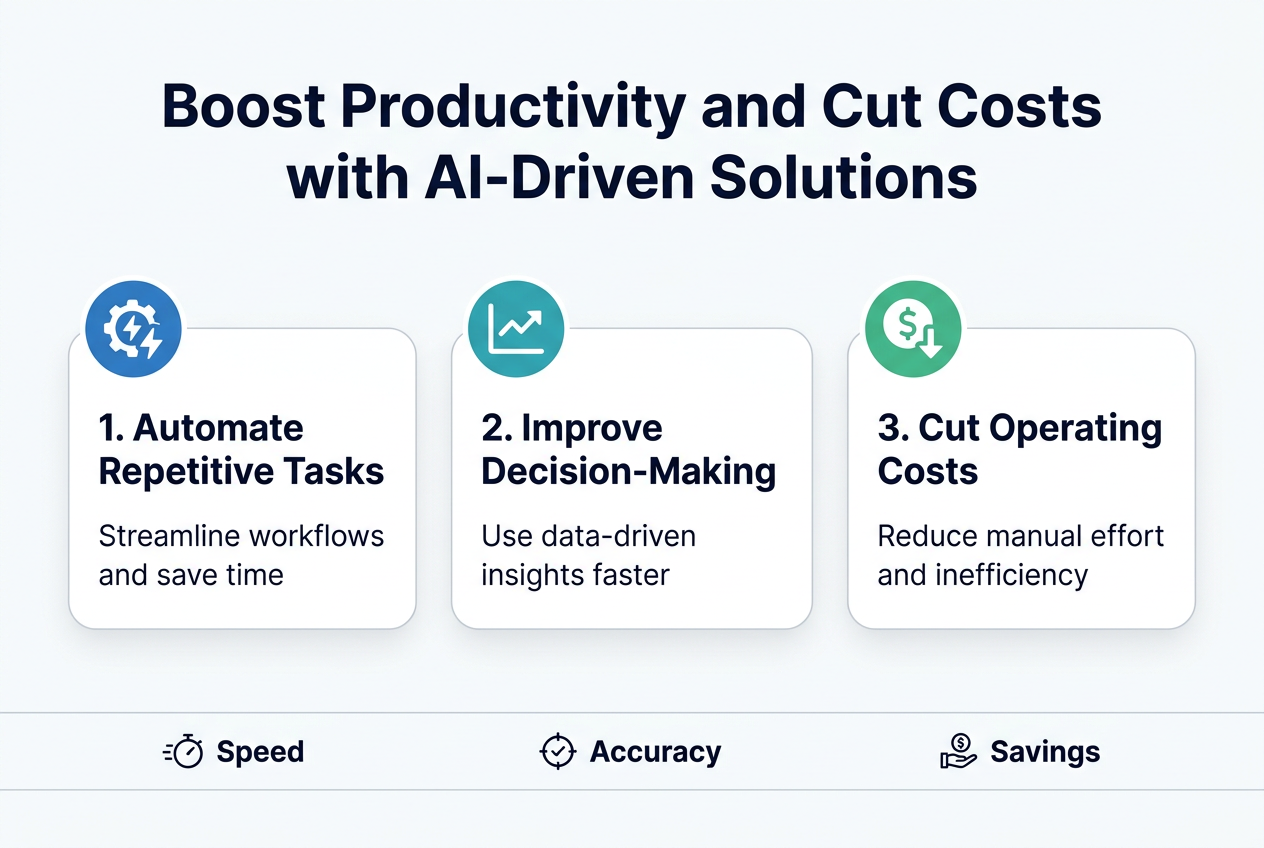
Reducing Manual Labor Expenses Through Intelligent Task Delegation
AI agents excel at taking over repetitive, time-consuming tasks that traditionally require human intervention. Instead of paying employees to manually process invoices, schedule appointments, or update spreadsheets, autonomous AI systems handle these responsibilities around the clock without breaks, sick days, or vacation time.
Consider a mid-sized accounting firm that deploys AI-driven solutions for data entry and client communication. The technology can process hundreds of transactions per hour while maintaining accuracy levels that surpass human capabilities. This shift allows skilled professionals to focus on strategic advisory services rather than mundane administrative work, effectively multiplying the value each employee brings to the organization.
Smart delegation doesn’t mean replacing your entire workforce overnight. AI agents work best when they complement human expertise, handling routine operations while freeing up talented staff for creative problem-solving and relationship building. The cost savings compound quickly – businesses typically see 30-40% reductions in operational expenses within the first year of implementing intelligent automation.
Minimizing Human Error in Critical Business Processes
Human mistakes cost businesses millions annually, from simple data entry errors to complex calculation mishaps that ripple through entire supply chains. Autonomous technology brings consistency and precision to processes where accuracy matters most.
Financial institutions use AI agents to verify transactions, flag suspicious activities, and ensure regulatory compliance without the fatigue factor that affects human analysts. These systems process thousands of data points simultaneously, cross-referencing information against multiple databases to catch discrepancies that might slip past even experienced professionals.
Manufacturing companies deploy intelligent automation to monitor quality control, adjusting production parameters in real-time based on sensor feedback. This proactive approach prevents defective products from reaching customers, protecting brand reputation while reducing costly recalls and warranty claims.
The beauty of AI-driven solutions lies in their ability to learn from patterns and improve over time. Unlike humans who might repeat the same mistakes under pressure, these systems continuously refine their decision-making processes, becoming more reliable with each iteration.
Accelerating Decision-Making with Real-Time Data Analysis
Modern businesses generate massive amounts of data every second, but traditional analysis methods can’t keep pace with this information flow. AI agents process real-time data streams, identifying trends, anomalies, and opportunities as they emerge rather than weeks later in quarterly reports.
Retail chains use autonomous AI systems to adjust pricing strategies based on competitor actions, inventory levels, and customer demand patterns. These adjustments happen within minutes, capturing sales opportunities that would be lost under manual review processes.
Investment firms rely on artificial intelligence for business operations to scan market conditions, news feeds, and economic indicators continuously. The technology can execute trades, rebalance portfolios, and manage risk exposure faster than any human trader could react to changing market conditions.
Real-time analysis extends beyond numbers and charts. AI productivity tools monitor customer service interactions, social media mentions, and employee productivity metrics, providing managers with actionable insights the moment intervention becomes necessary.
Scaling Operations Without Proportional Workforce Increases
Traditional business growth often requires hiring additional staff proportionally, creating linear cost increases that limit scalability. Automated business processes break this pattern by handling increased workloads without expanding payroll expenses.
E-commerce platforms demonstrate this principle perfectly. As order volumes increase during peak seasons, AI agents manage inventory allocation, customer inquiries, and shipping coordination without requiring seasonal hiring. The same autonomous AI systems that handle 100 orders daily can scale to manage 10,000 orders with minimal additional infrastructure costs.
Professional service firms use intelligent automation to onboard new clients without expanding their administrative teams. AI-driven solutions handle contract generation, compliance checks, and initial client communications, allowing the business to grow revenue while maintaining lean operational structures.
This scaling advantage becomes more pronounced as businesses expand globally. AI agents operate across time zones without shift differentials, manage multiple languages without translation delays, and adapt to local regulations without location-specific training requirements. The result is sustainable growth that improves profit margins rather than simply increasing revenue.
Navigate Implementation Challenges and Risk Management
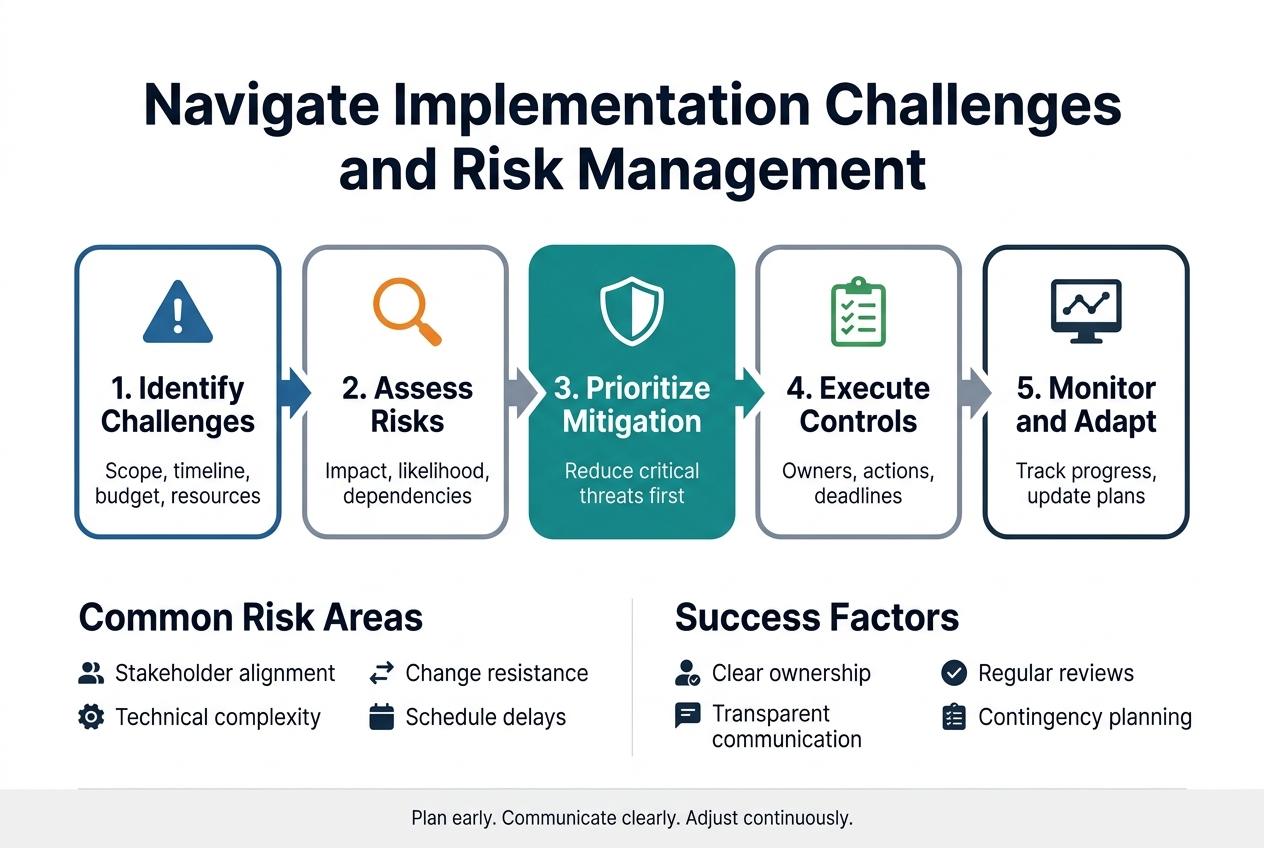
Addressing Data Security and Privacy Concerns
Deploying AI agents across your business operations opens up a whole new landscape of security challenges that traditional IT frameworks weren’t designed to handle. These autonomous systems process massive amounts of sensitive data, from customer information to proprietary business intelligence, creating multiple attack vectors that cybercriminals can exploit.
The first line of defense starts with implementing end-to-end encryption for all data flowing through your AI systems. Unlike static databases, AI agents constantly communicate with various endpoints, APIs, and cloud services, making data-in-transit encryption absolutely critical. Your autonomous technology needs robust authentication protocols that go beyond simple password protection – multi-factor authentication, biometric verification, and zero-trust security models become essential components.
Privacy concerns multiply when AI agents make automated decisions using personal customer data. GDPR, CCPA, and other privacy regulations require businesses to maintain strict control over how personal information gets processed and stored. Your AI implementation must include clear data lineage tracking, allowing you to trace exactly how customer data flows through your automated business processes.
Consider implementing data minimization strategies where your AI agents only access the specific information needed for their tasks. This reduces exposure risks and helps maintain compliance with privacy regulations. Regular security audits and penetration testing specifically designed for AI systems help identify vulnerabilities before they become serious problems.
Managing Employee Resistance and Workforce Transitions
Rolling out intelligent automation often triggers legitimate concerns among your workforce about job security and changing role requirements. Smart businesses approach this challenge proactively by treating AI implementation as a workforce evolution rather than replacement initiative.
Start by identifying which tasks your AI-driven solutions will handle versus which responsibilities require human expertise. Most successful deployments show that AI agents excel at repetitive, data-heavy tasks while humans focus on creative problem-solving, relationship building, and strategic decision-making. Communicating this division clearly helps employees understand their evolving value proposition.
Invest heavily in reskilling programs that prepare your team for AI-augmented roles. Your customer service representatives might transition from handling basic inquiries to managing complex customer relationships while AI agents handle routine questions. Sales teams can focus on relationship building while autonomous AI systems manage lead qualification and initial outreach.
Create change management teams that include employees from every affected department. These internal champions help address concerns, provide feedback on AI implementation, and identify potential issues before they disrupt operations. Regular town halls and training sessions keep everyone informed about the transition timeline and their role in the new AI-enhanced workflow.
Ensuring Regulatory Compliance in Automated Systems
Regulatory compliance becomes significantly more complex when autonomous AI systems make decisions previously handled by human oversight. Different industries face varying compliance requirements, but several universal principles apply to AI implementation across all sectors.
Financial services organizations must ensure their AI agents comply with fair lending practices, anti-discrimination laws, and audit trail requirements. Healthcare businesses need their artificial intelligence for business solutions to maintain HIPAA compliance while processing patient data. Manufacturing companies using automated business processes must adhere to safety regulations and quality standards.
Implement comprehensive logging systems that capture every decision your AI agents make, including the data inputs, reasoning process, and final outputs. These audit trails become crucial during regulatory inspections and help demonstrate that your autonomous systems operate within legal boundaries. Your logging should be immutable and easily accessible for compliance reporting.
Establish clear escalation protocols for situations where AI agents encounter scenarios outside their programmed parameters. Human oversight remains essential for edge cases, ethical dilemmas, and situations requiring judgment calls that current AI technology cannot reliably handle.
Regular compliance testing should specifically evaluate how your AI systems perform under various regulatory scenarios. This includes testing for bias in automated decisions, verifying data handling procedures, and ensuring that your AI productivity tools maintain the same compliance standards as human-operated processes.
Prepare Your Business for the AI Agent Revolution
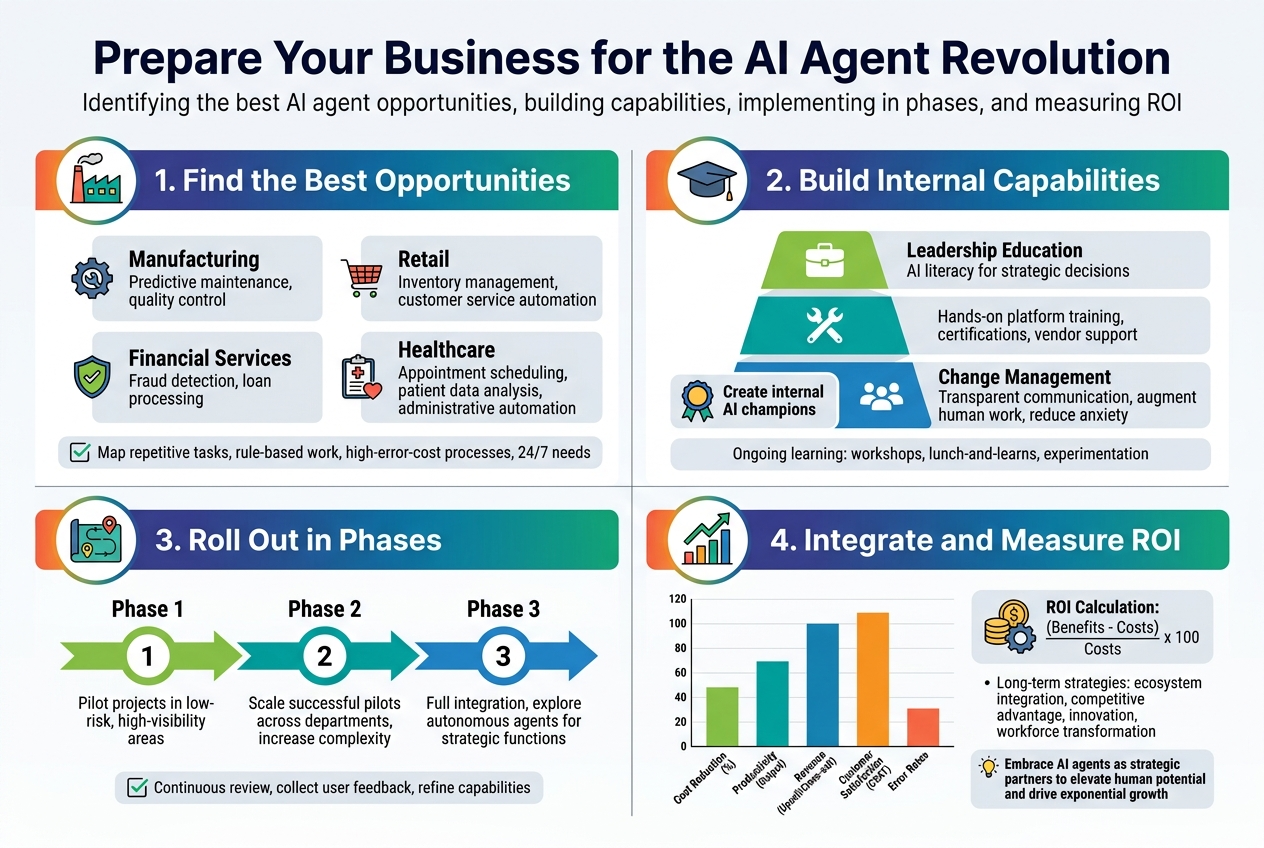
Identifying the best AI agent opportunities for your industry
The key to successful AI implementation starts with spotting the right opportunities within your specific business landscape. Different industries present unique automation possibilities, and understanding where AI agents can deliver maximum impact requires careful analysis of your current operations.
Manufacturing companies often find the biggest wins in predictive maintenance and quality control systems. AI agents can monitor equipment performance around the clock, predicting failures before they happen and automatically scheduling maintenance. Retail businesses typically see exceptional results from AI-driven inventory management and customer service automation, where intelligent systems handle routine inquiries while escalating complex issues to human staff.
Financial services benefit tremendously from AI agents in fraud detection and loan processing. These autonomous systems can analyze thousands of transactions per second, flagging suspicious activity and processing routine applications without human intervention. Healthcare organizations discover value in appointment scheduling, patient data analysis, and administrative task automation.
Start by mapping your most time-consuming, repetitive processes. Look for tasks that follow clear rules or patterns – these represent prime candidates for AI agent deployment. Consider areas where human error costs you money or where 24/7 availability would create competitive advantages.
Building internal capabilities and training programs
Creating a workforce ready for AI integration demands more than just purchasing new technology. Your team needs the skills and mindset to work alongside intelligent automation systems effectively.
Begin with leadership education. Executives and managers must understand AI capabilities and limitations before making strategic decisions. This doesn’t require technical expertise, but rather business-focused AI literacy that enables informed decision-making about implementation priorities and resource allocation.
Technical staff need hands-on training with the specific AI platforms and tools your organization plans to deploy. Partner with AI vendors for comprehensive training programs, or invest in certification courses that build practical skills. Many successful companies create internal AI champions – employees who become expert users and can train others.
Don’t overlook change management training for all employees. AI implementation often triggers anxiety about job security. Address these concerns directly through transparent communication about how AI agents will augment rather than replace human capabilities. Show employees how automation will free them from mundane tasks to focus on higher-value work that requires creativity, problem-solving, and emotional intelligence.
Establish ongoing learning programs since AI technology evolves rapidly. Regular workshops, lunch-and-learns, and hands-on experimentation sessions keep your team current with new capabilities and best practices.
Creating a phased implementation roadmap
Smart AI agent deployment follows a strategic, step-by-step approach that minimizes risk while maximizing learning opportunities. Rushing into comprehensive automation often leads to costly mistakes and employee resistance.
Phase one should focus on pilot projects in low-risk, high-visibility areas. Choose processes that are well-documented, have clear success metrics, and won’t disrupt core business operations if something goes wrong. Customer service chatbots or basic data entry automation often work well for initial pilots.
Phase two expands successful pilots and introduces AI agents to more complex processes. This might include automated report generation, email categorization, or simple decision-making workflows. Each expansion should build on lessons learned from previous implementations.
Phase three tackles mission-critical processes and advanced autonomous AI systems. By this stage, your team has developed confidence and expertise, making complex implementations more likely to succeed. This phase might include predictive analytics systems, automated financial processes, or sophisticated customer personalization engines.
Plan for 6-18 month phases, depending on your organization’s size and complexity. Build buffer time for unexpected challenges and employee adaptation periods. Document everything – successful strategies, common pitfalls, and performance improvements – to accelerate future implementations.
Measuring ROI and performance metrics for AI initiatives
Tracking AI agent performance requires metrics that capture both quantitative improvements and qualitative benefits. Traditional ROI calculations often miss the full value of intelligent automation.
Start with direct cost savings: reduced labor hours, decreased error rates, and eliminated manual processes. Calculate the time employees previously spent on automated tasks, then multiply by their hourly wages. Factor in reduced overtime costs and the ability to redirect human resources to revenue-generating activities.
Measure productivity gains through throughput metrics. How many more customer inquiries can your AI-powered service team handle? How much faster do automated processes complete compared to manual workflows? Track processing times, completion rates, and accuracy improvements.
Customer satisfaction often improves with AI implementation. Monitor response times, first-contact resolution rates, and customer feedback scores. AI agents frequently provide faster, more consistent service than human teams, especially for routine inquiries.
Don’t forget operational resilience benefits. AI agents work 24/7 without breaks, sick days, or vacation time. Calculate the value of continuous operation, especially for customer-facing processes or time-sensitive workflows.
Create dashboards that track key performance indicators in real-time. This enables quick adjustments and demonstrates ongoing value to stakeholders. Regular reporting on AI agent performance builds confidence and supports budget requests for expanded implementation.
Track unexpected benefits too – improved employee satisfaction from elimination of tedious tasks, enhanced data quality from automated processes, and new business opportunities enabled by AI capabilities. These soft benefits often justify AI investments even when direct ROI calculations are challenging.
AI agents are about to change the game for businesses everywhere. These smart systems can handle everything from customer service to data analysis, giving you more time to focus on what really matters – growing your company. The cost savings and productivity gains are real, and early adopters are already seeing impressive results.
Getting started doesn’t have to be overwhelming. Start small, pick one area where AI can make an immediate impact, and build from there. Yes, there are challenges to work through – security concerns, training your team, and choosing the right technology. But the businesses that start preparing now will have a huge advantage over those that wait. The AI agent revolution is happening whether you’re ready or not, so why not get ahead of the curve?