
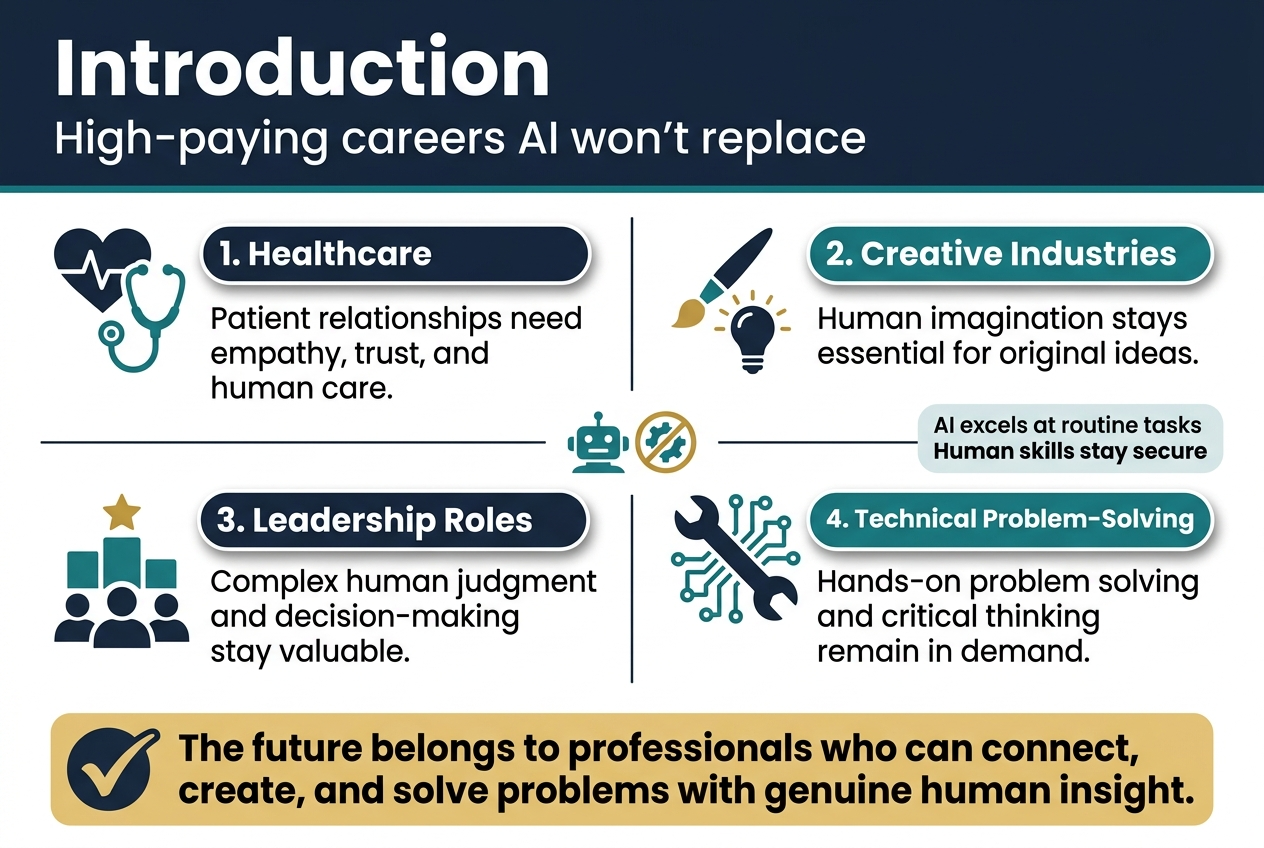
Artificial intelligence is reshaping the job market, but some high-paying careers AI won’t replace will always need the human touch. This guide is for professionals, career changers, and students who want to future-proof their earning potential in an increasingly automated world.
While robots and algorithms excel at routine tasks, AI-proof jobs that require emotional intelligence, creativity, and complex human judgment remain secure. These automation-proof jobs often pay well precisely because they demand uniquely human skills that machines can’t replicate.
We’ll explore why healthcare professionals who build patient relationships will always be essential, and how creative industries continue to value human imagination over artificial output. You’ll also discover which leadership roles and technical problem-solving careers offer the best future job security, plus practical strategies to position yourself in these AI-resistant fields.
The future belongs to professionals who can do what AI cannot: connect, create, and solve problems with genuine human insight.
Why Certain Professions Remain Beyond AI’s Reach
Human Creativity and Emotional Intelligence as Irreplaceable Assets
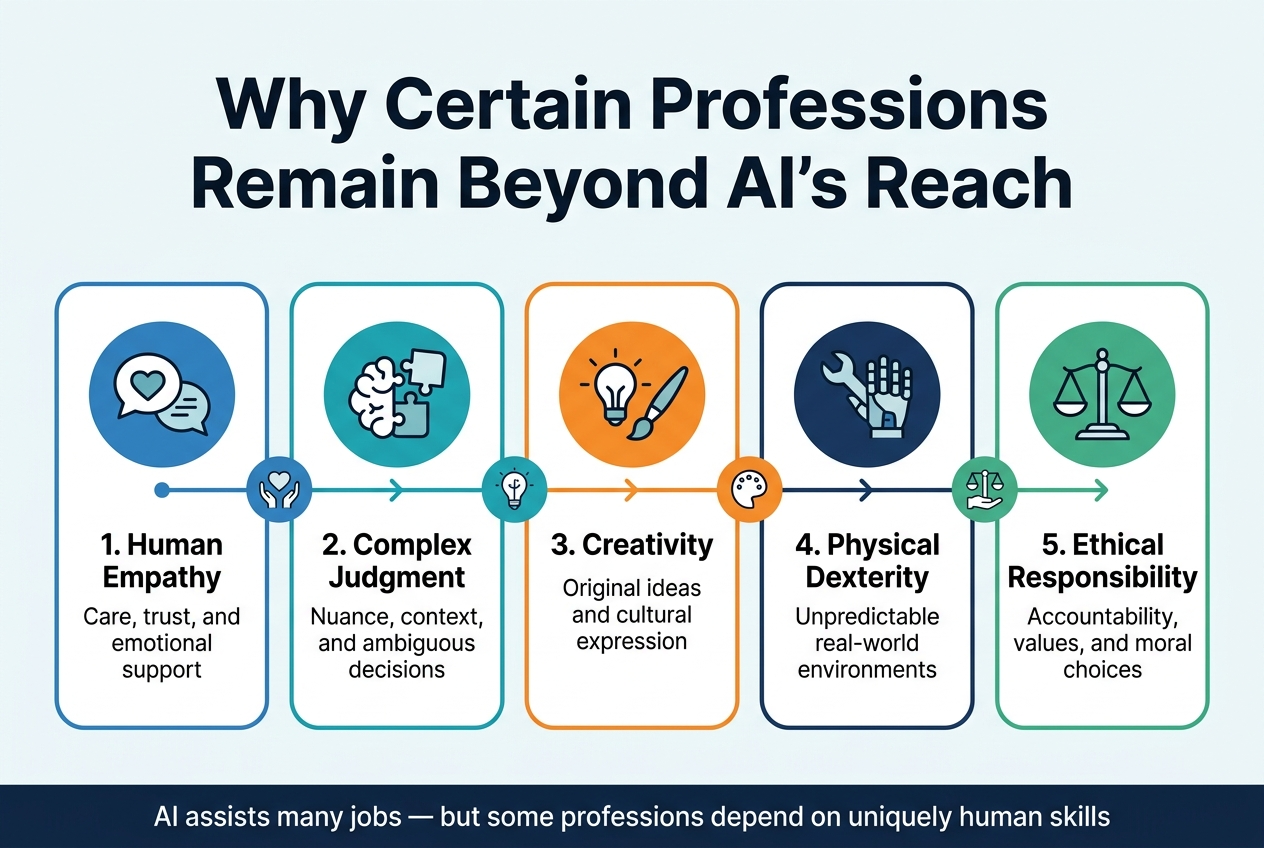
Machines can crunch numbers and analyze data faster than any human ever could, but they can’t replicate the spark of genuine creativity or the depth of emotional understanding that defines our humanity. When a therapist sits across from a client struggling with depression, they’re drawing on years of experience, intuitive understanding, and the ability to read subtle emotional cues that no algorithm can match.
AI-proof jobs in creative fields showcase this perfectly. A novelist doesn’t just string words together—they weave complex emotions, create compelling characters, and tap into universal human experiences. While AI can generate text, it lacks the lived experience and emotional depth that makes stories truly resonate with readers. The same applies to artists, musicians, and designers who infuse their work with personal vision and cultural understanding.
Emotional intelligence extends far beyond creative work. Sales professionals who build lasting client relationships, negotiators who navigate complex business deals, and customer service representatives who turn angry customers into loyal advocates all rely on uniquely human abilities. They read between the lines, pick up on emotional subtext, and adapt their approach based on subtle social cues that current AI simply cannot process.
Complex Problem-Solving Requiring Intuition and Experience
Real-world problem-solving often demands the kind of intuitive leaps and contextual understanding that comes from years of hands-on experience. A master craftsperson can look at a piece of wood and instantly know how it will behave under different conditions, while an experienced surgeon can make split-second decisions during an operation based on countless similar situations they’ve encountered.
High-paying careers AI won’t replace frequently involve this type of nuanced decision-making. Emergency room doctors don’t just follow diagnostic flowcharts—they synthesize incomplete information, recognize patterns from their experience, and make critical decisions under pressure. Similarly, senior engineers working on complex infrastructure projects draw on decades of experience to anticipate problems that might not show up in computer models.
These professionals excel because they can think outside established parameters. When faced with unprecedented situations, they combine technical knowledge with intuitive understanding to develop innovative solutions. This adaptability and creative problem-solving capacity remains uniquely human.
Jobs Demanding Physical Dexterity and Real-World Adaptability
The physical world presents countless variables and unexpected challenges that robots struggle to handle. While manufacturing robots excel in controlled environments with predictable tasks, many automation-proof jobs require the kind of adaptability and fine motor skills that humans possess naturally.
Skilled tradespeople like electricians, plumbers, and HVAC technicians work in constantly changing environments. One day they might be crawling through a cramped attic, the next they’re troubleshooting a unique problem in a century-old building. Each job site presents different challenges, requires different tools, and demands real-time adaptation that current robotics can’t match.
Careers requiring human skills in physical trades also involve significant diagnostic abilities. When a master mechanic listens to an engine, they’re processing subtle auditory cues, feeling vibrations, and drawing on experience to identify problems that sophisticated diagnostic computers might miss. This combination of sensory perception, physical dexterity, and experiential knowledge creates a powerful problem-solving toolkit.
Roles Requiring Ethical Judgment and Moral Reasoning
Perhaps the most fundamentally human aspect of work involves making ethical decisions and exercising moral judgment. These responsibilities can’t be programmed into algorithms because they require understanding context, weighing competing values, and making decisions that reflect human dignity and social responsibility.
Judges and lawyers don’t simply apply rules mechanically—they interpret laws within specific contexts, consider the human impact of their decisions, and balance competing interests. A family court judge deciding custody arrangements must weigh complex factors including child welfare, parental rights, and family dynamics that extend far beyond what any algorithm could process.
Human-centric professions in fields like social work, counseling, and nonprofit leadership require constant ethical decision-making. These professionals navigate situations where technical solutions fall short and human wisdom becomes essential. They advocate for vulnerable populations, make resource allocation decisions under constraints, and help people through some of life’s most challenging moments.
Healthcare professionals face similar ethical complexities daily. Beyond medical knowledge, they must consider patient autonomy, quality of life issues, and cultural sensitivities. When a doctor discusses treatment options with a terminal patient, they’re not just presenting medical facts—they’re providing compassionate guidance through one of life’s most difficult conversations.
Healthcare Professionals Who Thrive on Human Connection
Surgeons combining precision with split-second decision making
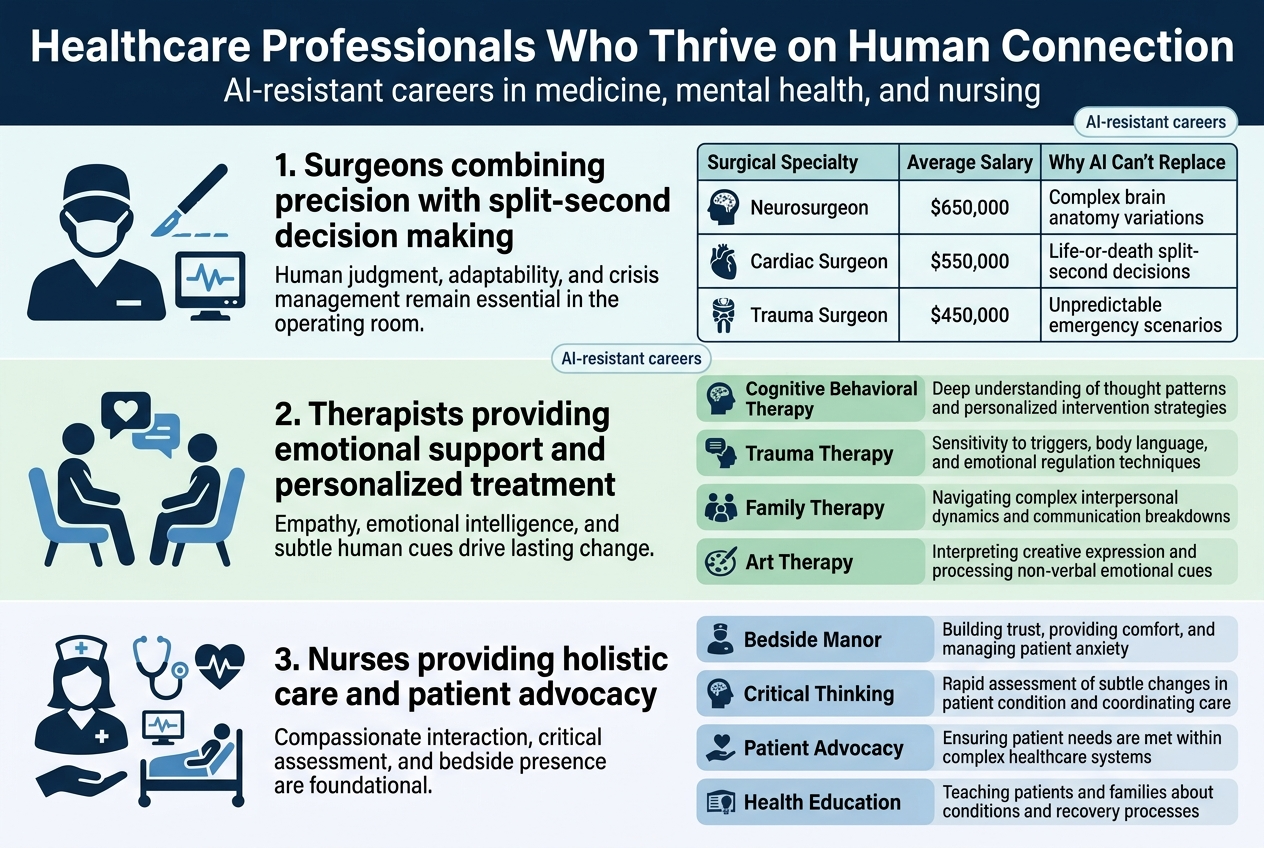
Operating rooms represent one of the most complex environments where AI-resistant careers truly shine. While surgical robots can enhance precision, they remain tools guided by human expertise, judgment, and adaptability. Surgeons earning $400,000 to $700,000 annually possess an irreplaceable combination of technical skill, pattern recognition, and crisis management that no algorithm can replicate.
The human brain’s ability to process unexpected complications during surgery remains unmatched. When a patient’s blood pressure suddenly drops or an unusual anatomical variation appears, surgeons draw from years of training, intuition, and experience to make life-saving decisions within seconds. These automation-proof jobs require professionals who can think creatively under extreme pressure, communicate with surgical teams, and adapt procedures in real-time based on constantly changing variables.
Surgical specialties like neurosurgery, cardiac surgery, and trauma surgery command the highest salaries precisely because they demand this unique blend of technical mastery and human judgment. Even as robotic assistance becomes more sophisticated, the surgeon’s role as decision-maker, problem-solver, and leader remains central to patient outcomes.
| Surgical Specialty | Average Salary | Why AI Can’t Replace |
|---|---|---|
| Neurosurgeon | $650,000 | Complex brain anatomy variations |
| Cardiac Surgeon | $550,000 | Life-or-death split-second decisions |
| Trauma Surgeon | $450,000 | Unpredictable emergency scenarios |
Therapists providing emotional support and personalized treatment
Mental health professionals represent some of the most secure high-paying careers AI won’t replace, with experienced therapists earning $80,000 to $200,000 annually. The therapeutic relationship builds on empathy, emotional intelligence, and the ability to read subtle human cues that artificial intelligence simply cannot interpret or respond to authentically.
Successful therapy requires understanding cultural nuances, family dynamics, trauma responses, and individual personality traits. Therapists must build trust, challenge patients appropriately, and know when to push boundaries or provide comfort. This delicate balance of professional expertise and human connection creates lasting behavioral change that no chatbot or algorithm can achieve.
Different therapeutic modalities showcase why these remain jobs safe from artificial intelligence:
- Cognitive Behavioral Therapy: Requires deep understanding of thought patterns and personalized intervention strategies
- Trauma Therapy: Demands sensitivity to triggers, body language, and emotional regulation techniques
- Family Therapy: Involves navigating complex relationship dynamics and cultural considerations
- Addiction Counseling: Needs compassion, motivation techniques, and understanding of relapse patterns
Marriage and family therapists, clinical psychologists, and specialized trauma counselors continue seeing growing demand as society recognizes mental health’s importance. Their work involves creativity, intuition, and the ability to connect with people from diverse backgrounds—skills that make these human-centric professions irreplaceable.
Nurses delivering compassionate care and patient advocacy
Registered nurses represent the backbone of healthcare, earning $75,000 to $120,000 annually while providing irreplaceable human connection during patients’ most vulnerable moments. These future job security positions combine clinical expertise with emotional intelligence, making them among the most automation-resistant roles in healthcare.
Patient advocacy stands as nursing’s most uniquely human responsibility. Nurses serve as intermediaries between patients, families, and medical teams, ensuring voices are heard and concerns addressed. They recognize when something feels “off” with a patient, even when vital signs appear normal, relying on experience and intuition that AI cannot replicate.
Critical nursing specialties demonstrate why these remain careers requiring human skills:
- ICU Nurses: Monitor complex patients, provide family support during crises
- Oncology Nurses: Offer emotional support throughout cancer treatment journeys
- Pediatric Nurses: Communicate with children and anxious parents
- Emergency Room Nurses: Triage patients under pressure, provide crisis support
- Hospice Nurses: Guide families through end-of-life care with compassion
Advanced practice nurses, including nurse practitioners and nurse anesthetists, earn $110,000 to $180,000 annually. They combine clinical decision-making with patient education, relationship building, and holistic care approaches that address patients’ physical, emotional, and social needs.
The nursing shortage continues creating opportunities for these AI-proof jobs, as healthcare systems recognize that technology enhances rather than replaces nursing care. Patients consistently report that nurses’ compassion, advocacy, and human presence significantly impact their healing experience—qualities that ensure nursing remains one of the most secure healthcare professions in an AI-driven future.
Creative Industries Where Human Imagination Reigns Supreme
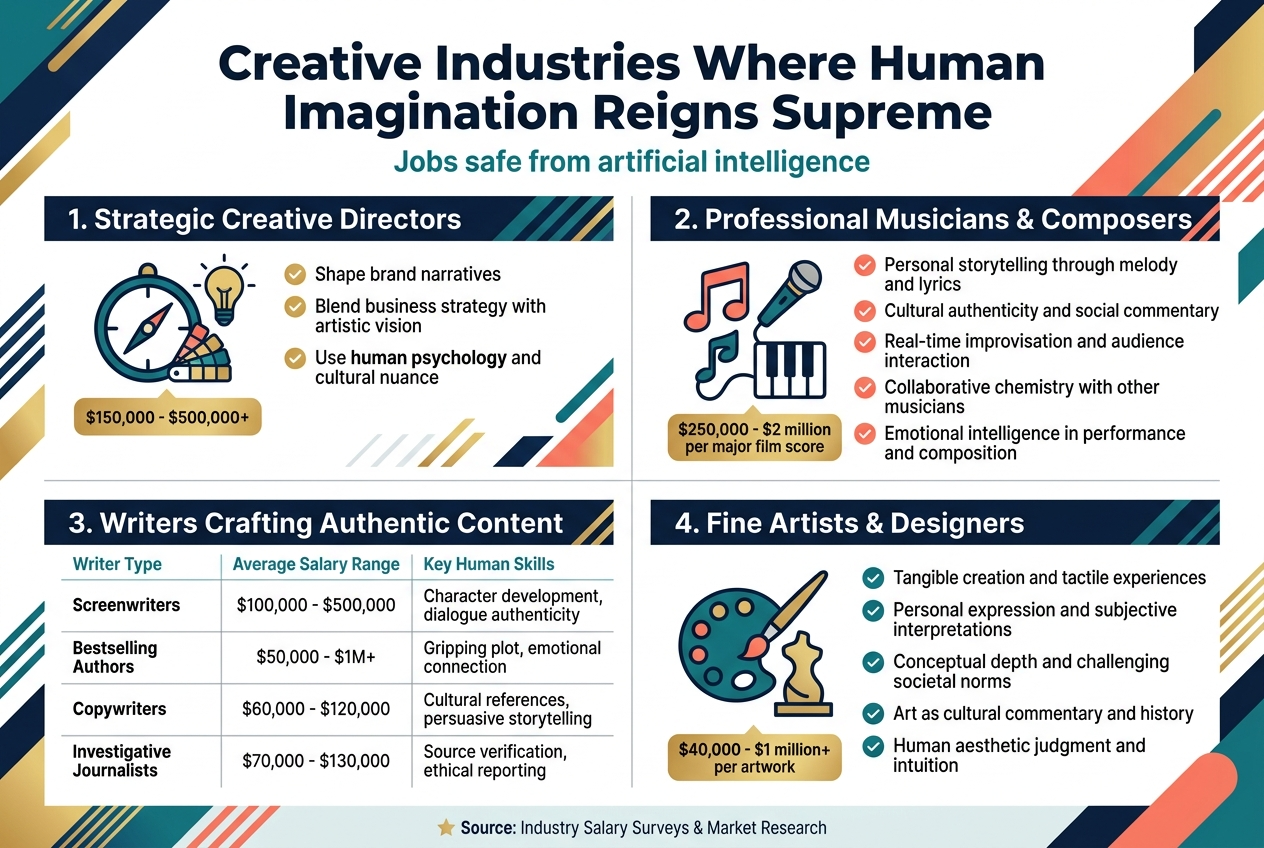
Strategic Creative Directors Shaping Brand Narratives
Strategic creative directors operate at the intersection of business strategy and artistic vision, making them irreplaceable in today’s market. These professionals don’t just design pretty visuals—they craft entire brand experiences that resonate with human emotions and cultural nuances. AI can generate logos or color palettes, but it can’t understand the deep psychological connections that drive consumer behavior across different demographics and cultural contexts.
The role demands an intimate understanding of human psychology, market trends, and brand storytelling that goes far beyond data analysis. Creative directors must navigate complex client relationships, inspire diverse creative teams, and make split-second decisions that can make or break multi-million dollar campaigns. They synthesize market research, consumer insights, and cultural zeitgeist into compelling brand narratives that speak directly to human desires and aspirations.
Top-tier creative directors at major agencies and corporations command salaries ranging from $150,000 to $500,000 annually, with additional profit-sharing and bonuses. Their ability to translate abstract business goals into tangible creative strategies makes them invaluable assets in an increasingly competitive marketplace.
Professional Musicians and Composers Creating Original Works
Music creation remains one of the most fundamentally human-centric professions, deeply rooted in personal experience, cultural interpretation, and emotional expression. While AI can analyze musical patterns and generate basic compositions, it cannot replicate the lived experiences, cultural backgrounds, and emotional depth that drive truly compelling musical works.
Professional musicians and composers bring irreplaceable elements to their craft:
- Personal storytelling through melody and lyrics
- Cultural authenticity and social commentary
- Real-time improvisation and audience interaction
- Collaborative chemistry with other musicians
- Emotional intelligence in performance and composition
Successful musicians, film composers, and songwriters often earn substantial incomes through multiple revenue streams. Film composers can earn $250,000 to $2 million per major motion picture, while touring musicians and recording artists generate income through performance fees, royalties, and merchandise. The human connection between artist and audience creates loyalty that algorithms simply cannot replicate.
Writers Crafting Compelling Stories and Authentic Content
Content creation might seem vulnerable to AI advancement, but skilled writers who focus on authentic storytelling and deep audience connection remain highly sought after. The key lies in moving beyond formulaic content toward genuine human insights, personal experiences, and nuanced perspectives that resonate with readers on an emotional level.
Professional writers in AI-resistant careers include:
| Writer Type | Average Salary Range | Key Human Skills |
|---|---|---|
| Screenwriters | $100,000 – $500,000 | Character development, dialogue authenticity |
| Bestselling Authors | $75,000 – $1,000,000+ | Narrative voice, cultural insight |
| Brand Storytellers | $80,000 – $200,000 | Audience psychology, brand voice |
| Investigative Journalists | $60,000 – $150,000 | Source relationships, ethical judgment |
The most successful writers understand that their value lies not in churning out content, but in providing unique perspectives, conducting original research, and building genuine connections with their audiences. They leverage their personal experiences, cultural knowledge, and emotional intelligence to create content that feels authentically human.
Film Directors Bringing Unique Visions to Life
Film direction represents one of the most complex creative leadership roles, requiring directors to orchestrate dozens of moving parts while maintaining a cohesive artistic vision. Directors must manage actors, cinematographers, editors, and countless crew members while making thousands of creative decisions that shape the final product.
The director’s role encompasses multiple human-centric professions within a single position:
- Emotional coaching for actors to deliver authentic performances
- Visual storytelling that conveys subtext and meaning
- Leadership and motivation of large, diverse teams
- Real-time problem-solving under pressure and tight deadlines
- Cultural sensitivity and social responsibility in storytelling
Successful directors earn between $200,000 and $20 million per project, depending on their track record and the film’s budget. Their ability to translate written scripts into compelling visual narratives while managing complex human dynamics makes them irreplaceable in the entertainment industry.
The creative industries offer some of the most secure jobs safe from artificial intelligence because they require the full spectrum of human capabilities—emotional intelligence, cultural understanding, personal experience, and the ability to connect with audiences on a deeply human level. These professionals don’t just create content; they create meaning, connection, and cultural impact that resonates across communities and generations.
Leadership Roles Requiring Emotional Intelligence and Vision
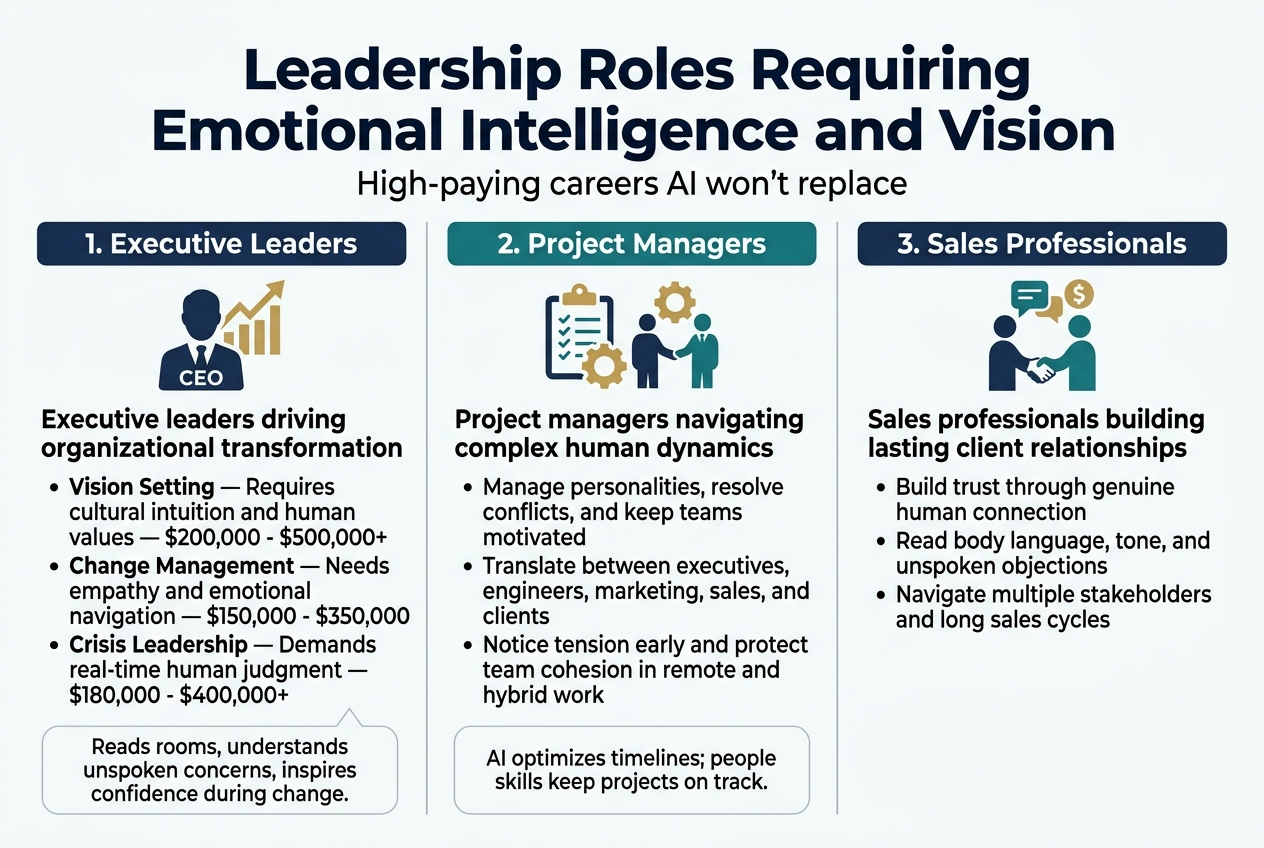
Executive leaders driving organizational transformation
Executive leadership remains one of the most secure high-paying careers AI won’t replace because it demands something machines simply can’t replicate: the ability to inspire, envision, and navigate complex human emotions during periods of change. When organizations face disruption—whether from market shifts, technological advances, or competitive pressures—they need leaders who can read between the lines of what employees aren’t saying, understand cultural undercurrents, and craft messages that resonate on both logical and emotional levels.
Top executives earn their substantial salaries by making judgment calls that require deep understanding of human psychology, stakeholder relationships, and organizational culture. A CEO deciding whether to pursue a risky acquisition doesn’t just crunch numbers—they assess team morale, evaluate cultural fit, and consider how the decision will impact employee trust and market perception. These nuanced evaluations require emotional intelligence that AI cannot match.
| Leadership Skill | Why AI Can’t Replace It | Average Salary Range |
|---|---|---|
| Vision Setting | Requires cultural intuition and human values | $200,000 – $500,000+ |
| Change Management | Needs empathy and emotional navigation | $150,000 – $350,000 |
| Crisis Leadership | Demands real-time human judgment | $180,000 – $400,000+ |
The most successful executives excel at reading rooms, understanding unspoken concerns, and adapting their communication style to different audiences. When a major restructuring threatens job security, employees need leaders who can acknowledge their fears while painting a compelling picture of the future. AI can analyze data and suggest optimal organizational structures, but it can’t hold someone’s hand through uncertainty or inspire confidence during turbulent times.
Project managers navigating complex human dynamics
Project management has evolved far beyond scheduling tasks and tracking deadlines. Today’s AI-proof jobs in project management center on the human element—managing personalities, resolving conflicts, and keeping diverse teams motivated toward common goals. While AI excels at optimizing timelines and resource allocation, it struggles with the messy reality of human collaboration.
Successful project managers earn their high salaries by becoming masters of human psychology. They know when to push a perfectionist team member to move faster, how to motivate a disengaged contributor, and which team members work best together. When a critical project hits roadblocks, it’s rarely about technical failures—it’s about communication breakdowns, personality clashes, or misaligned expectations.
The best project managers develop an almost supernatural ability to sense team dynamics. They notice when someone checks out mentally during meetings, recognize when two team members have unspoken tension, and intervene before small issues become project-derailing problems. This emotional intelligence becomes even more valuable as remote and hybrid work arrangements create new challenges in team cohesion.
Project managers also serve as translators between different organizational languages. They help engineers explain technical constraints to marketing teams, assist sales professionals in setting realistic expectations with clients, and bridge the gap between executive vision and ground-level execution. This translation work requires deep understanding of how different professionals think, communicate, and prioritize their work.
Sales professionals building lasting client relationships
High-performing sales professionals represent some of the most automation-proof jobs because they excel at something AI fundamentally cannot do: build genuine human connections that drive long-term business relationships. While AI can analyze customer data and suggest optimal timing for outreach, it can’t replicate the trust-building conversations that lead to major deals and lasting partnerships.
Top salespeople earn substantial incomes by becoming trusted advisors rather than just product pitchers. They invest time understanding their clients’ unspoken concerns, industry challenges, and personal motivations. When a potential client hesitates before signing a contract, experienced sales professionals can read body language, voice tone, and conversational patterns to understand the real objections—which often have nothing to do with price or product features.
The relationship-building aspect of sales becomes increasingly valuable as business decisions grow more complex. B2B sales cycles often involve multiple stakeholders, each with different priorities and concerns. Successful sales professionals navigate these complex human networks, understanding who influences decisions, how to address individual concerns, and when to apply pressure versus when to step back.
Elite salespeople also excel at creative problem-solving that goes beyond their product offerings. They might connect clients with other vendors, suggest alternative approaches to business challenges, or provide industry insights that help clients succeed—all while building the foundation for future opportunities. This consultative approach requires emotional intelligence, industry knowledge, and genuine care for client success that AI cannot authentically replicate.
Technical Experts in Complex Problem-Solving Fields
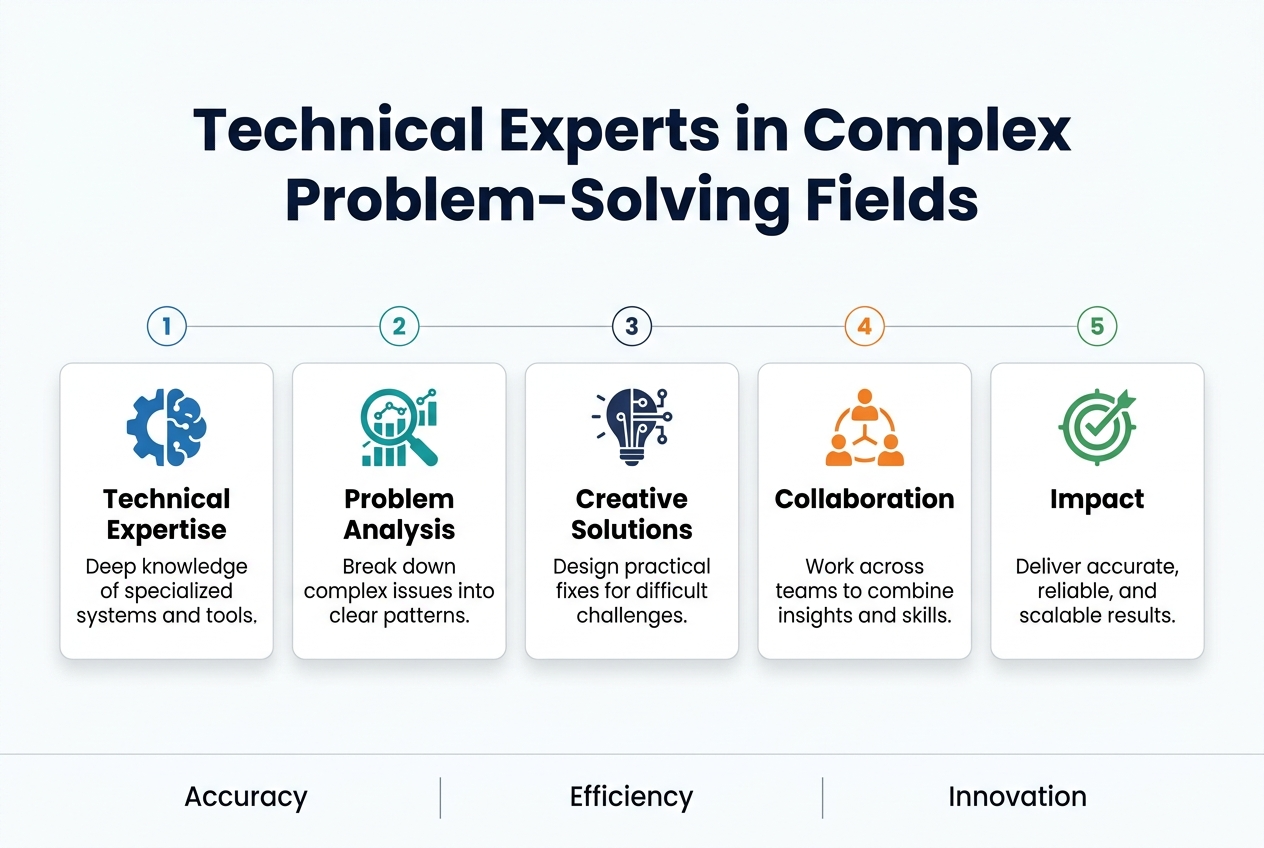
Research Scientists Pushing Boundaries of Human Knowledge
Research scientists represent some of the most AI-proof jobs available today, combining intellectual curiosity with methodical investigation that requires uniquely human traits. These professionals design experiments, interpret complex data patterns, and make intuitive leaps that connect seemingly unrelated phenomena. While AI excels at processing vast datasets, it lacks the creative hypothesis formation and ethical reasoning that drive groundbreaking discoveries.
Biomedical researchers developing new treatments earn between $95,000-$180,000 annually, with senior research directors commanding salaries exceeding $250,000. Their work involves understanding human biology’s intricacies, designing clinical trials, and navigating ethical considerations that require emotional intelligence and moral reasoning. AI can analyze genomic data, but it cannot understand the human experience of illness or make compassionate decisions about experimental treatments.
Environmental scientists studying climate change exemplify another secure career path. They integrate data from multiple sources, conduct fieldwork in unpredictable conditions, and communicate findings to diverse audiences. Their ability to adapt research methods based on unexpected field conditions and translate complex scientific concepts for policymakers makes them irreplaceable.
| Research Field | Salary Range | AI-Resistant Elements |
|---|---|---|
| Biomedical Research | $95,000-$250,000+ | Ethical reasoning, human empathy |
| Environmental Science | $70,000-$150,000 | Adaptability, policy communication |
| Materials Science | $85,000-$175,000 | Creative problem-solving, innovation |
Skilled Tradespeople Mastering Intricate Manual Work
Skilled trades represent high-paying careers AI won’t replace due to their reliance on tactile expertise, spatial reasoning, and adaptive problem-solving in unpredictable environments. Master electricians, plumbers, and HVAC specialists earn $75,000-$120,000 annually, with specialized technicians in industrial settings commanding even higher salaries.
Electrical work exemplifies why these positions remain secure. Every building presents unique challenges requiring immediate adaptation. An electrician troubleshooting a power issue must interpret subtle visual cues, feel for heat variations, listen to unusual sounds, and smell potential burning components. This multisensory diagnostic approach, combined with the dexterity needed for precise wire manipulation in cramped spaces, creates an insurmountable barrier for robotic automation.
Master craftsmen in specialized trades like instrument repair, precision machining, or custom cabinetry earn $90,000-$180,000 annually. Their expertise involves reading material properties through touch, adjusting techniques based on subtle feedback, and creating solutions for problems they’ve never encountered before. These professionals often spend decades developing intuitive understanding that cannot be programmed or replicated.
Automation-proof jobs in the trades also include:
- Underwater welders earning $100,000-$200,000
- Aircraft maintenance technicians making $85,000-$130,000
- Elevator installers and repairers earning $95,000-$150,000
Cybersecurity Specialists Protecting Against Evolving Threats
Cybersecurity professionals earn some of the highest salaries among careers requiring human skills, with senior specialists commanding $120,000-$300,000 annually. These roles remain secure because cybercriminals constantly evolve their tactics, requiring human creativity and intuition to anticipate and counter new threats.
Ethical hackers and penetration testers think like criminals to identify vulnerabilities before malicious actors exploit them. This requires psychological insight into human behavior, creative thinking about attack vectors, and the ability to communicate technical risks to non-technical stakeholders. While AI can scan for known vulnerabilities, it cannot anticipate the next innovative attack method or understand the human psychology driving cybercrime.
Security architects designing comprehensive protection systems must balance multiple competing priorities: user convenience, system performance, regulatory compliance, and threat protection. They make judgment calls about acceptable risk levels and create policies that account for human behavior patterns. This strategic thinking, combined with the need to stay ahead of rapidly evolving threats, makes these positions among the most AI-resistant careers.
Future job security in cybersecurity also extends to:
- Chief Information Security Officers earning $200,000-$500,000+
- Incident response specialists making $95,000-$175,000
- Security compliance managers earning $110,000-$190,000
Software Architects Designing Innovative System Solutions
Software architects represent the pinnacle of high-salary jobs immune to AI, earning $140,000-$350,000 annually while designing complex systems that solve real-world problems. These professionals combine deep technical knowledge with strategic business understanding and creative problem-solving abilities that AI cannot replicate.
System design requires understanding user needs, business constraints, technical limitations, and future scalability requirements simultaneously. Architects must make trade-offs between competing priorities while envisioning solutions that don’t yet exist. They translate abstract business requirements into concrete technical specifications, requiring both analytical and creative thinking.
The most successful software architects excel at pattern recognition across domains, seeing connections between seemingly unrelated systems and applying solutions from one field to problems in another. This cross-pollination of ideas, combined with the ability to communicate complex technical concepts to diverse stakeholders, ensures their continued relevance in an AI-driven world.
Human-centric professions in software architecture include:
- Enterprise architects earning $160,000-$280,000
- Cloud solution architects making $130,000-$220,000
- Platform architects commanding $150,000-$300,000+
These roles remain secure because they require understanding human behavior, business strategy, and technical implementation in ways that demand creativity, empathy, and strategic thinking that current AI systems cannot provide.
Education and Development Professionals Shaping Human Potential
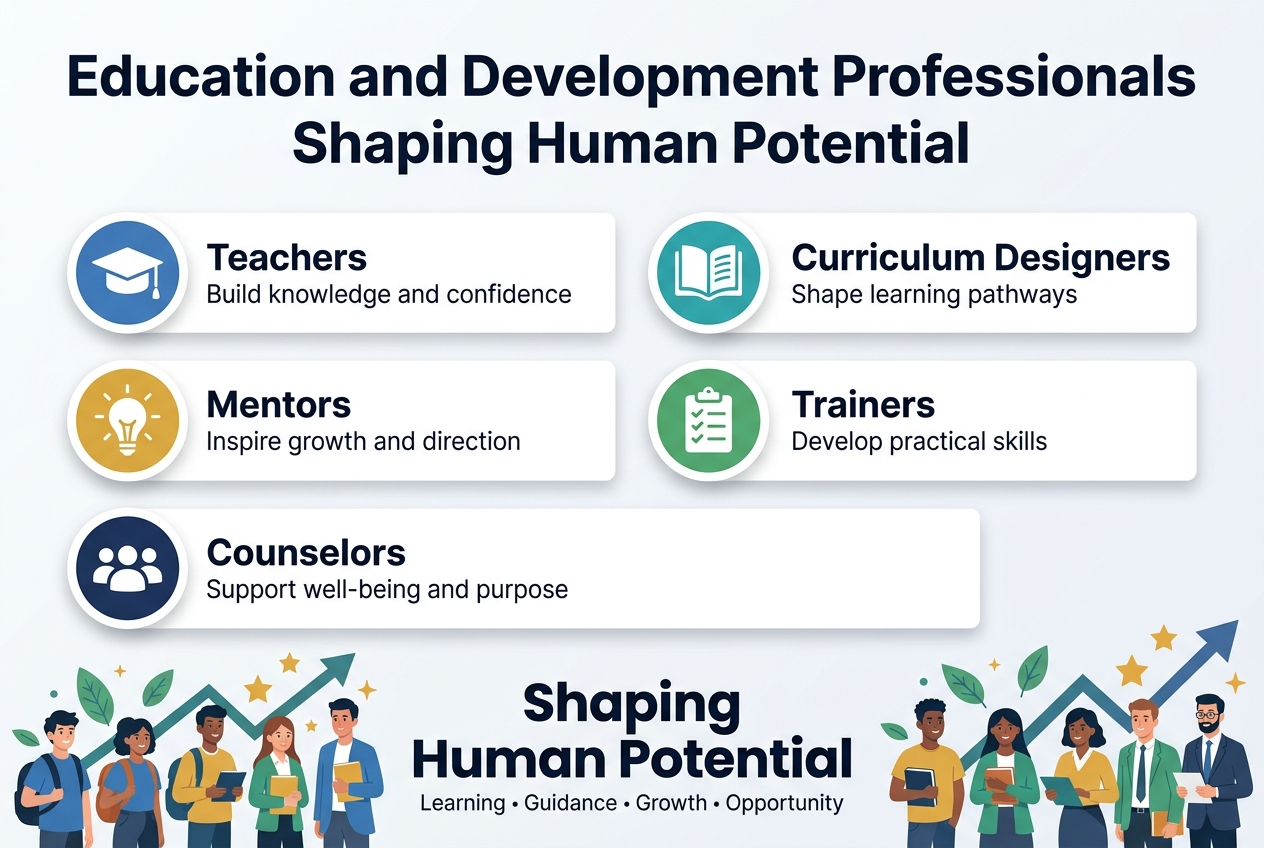
Teachers inspiring and mentoring future generations
The relationship between teacher and student represents one of humanity’s most profound connections. While AI can deliver information and even provide basic feedback, it can’t replace the intuitive understanding that experienced educators bring to the classroom. Master teachers read the room, sensing when a student struggles with self-doubt or when another needs an extra challenge to stay engaged.
These AI-resistant careers demand emotional intelligence that machines simply cannot replicate. A kindergarten teacher who notices a child’s reluctance to participate and gently coaxes them into group activities uses skills far beyond data processing. High school educators who inspire struggling students to pursue college dreams tap into motivation and belief systems that AI cannot access or influence.
The financial prospects for exceptional teachers continue to grow, especially for those who specialize in high-demand subjects or work in private institutions. Master teachers in mathematics, sciences, and specialized programs often earn six-figure salaries, making teaching one of the most secure high-paying careers AI won’t replace.
Training specialists developing human capabilities
Corporate training specialists and professional development experts occupy a unique position in the future of work trends. They understand how adults learn, adapt, and grow in professional environments. These specialists design programs that account for different learning styles, workplace cultures, and individual career goals.
The most successful training professionals excel at creating experiential learning opportunities. They facilitate role-playing exercises, lead difficult conversations about workplace dynamics, and help teams navigate complex interpersonal challenges. Their ability to read group dynamics and adjust approaches in real-time makes them invaluable in an increasingly complex business world.
| Specialization Area | Average Salary Range | AI Replacement Risk |
|---|---|---|
| Executive Coaching | $75,000 – $200,000+ | Very Low |
| Leadership Development | $65,000 – $150,000 | Low |
| Technical Skills Training | $60,000 – $120,000 | Low-Medium |
| Soft Skills Development | $55,000 – $130,000 | Very Low |
These human-centric professions require deep understanding of psychology, organizational behavior, and individual motivation patterns that AI cannot master.
Educational consultants creating personalized learning experiences
Educational consultants represent the pinnacle of customized learning design. They assess individual learning needs, family dynamics, and long-term educational goals to create comprehensive strategies for student success. These professionals often work with families navigating learning disabilities, gifted education programs, or complex school transitions.
The most effective consultants combine educational theory with practical experience across multiple learning environments. They understand how different schools approach various challenges and can match students with programs that align with their specific needs and learning styles.
Private educational consultants regularly command fees ranging from $150 to $500 per hour, with comprehensive college planning services often exceeding $10,000 per student. This makes educational consulting one of the most lucrative automation-proof jobs in the education sector.
Their expertise extends beyond academic planning to include social-emotional development, extracurricular guidance, and family communication strategies. They serve as translators between parents, students, and educational institutions, facilitating conversations and decisions that shape young people’s futures.
The personal nature of this work ensures these jobs safe from artificial intelligence will continue thriving as parents increasingly seek expert guidance in navigating complex educational landscapes.
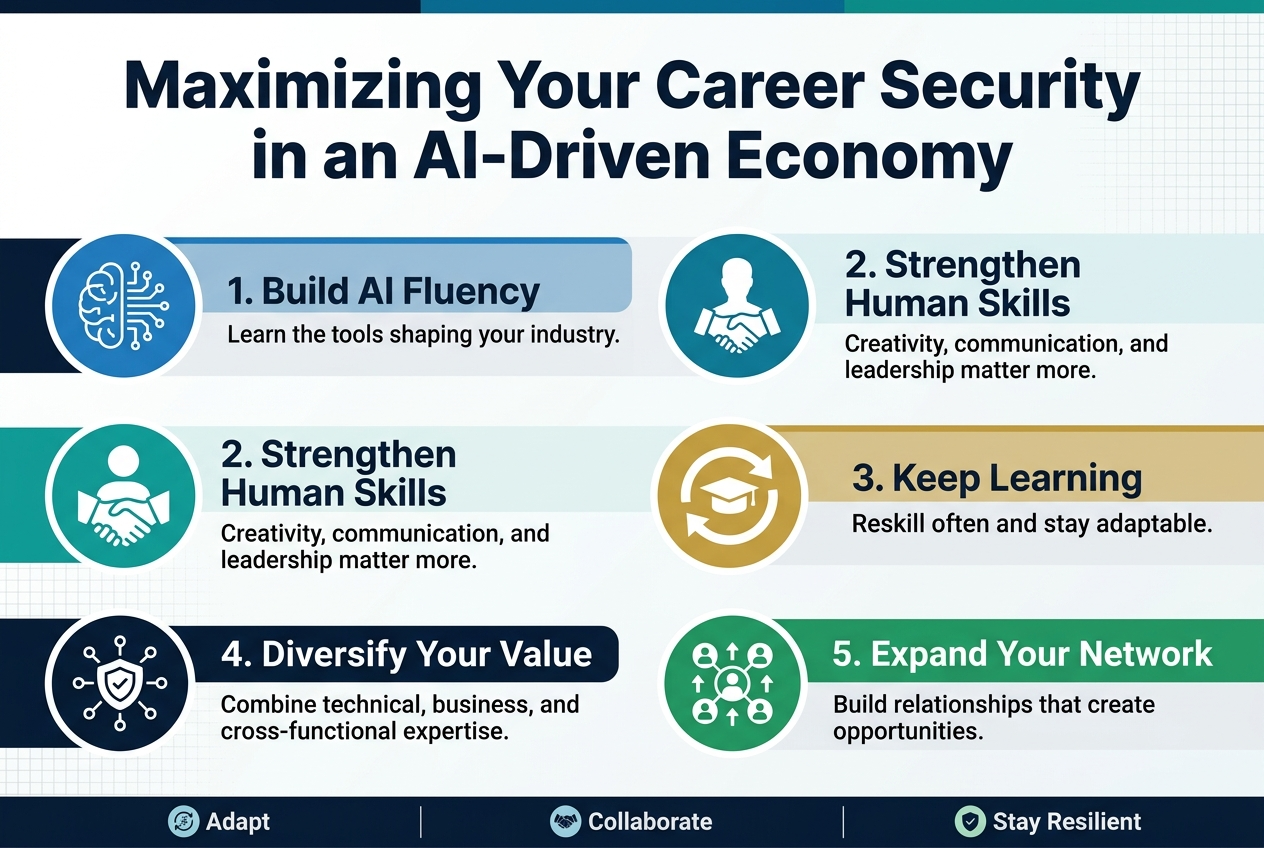
Maximizing Your Career Security in an AI-Driven Economy
Developing uniquely human skills that complement technology
Technology works best when paired with distinctly human capabilities. While AI excels at data processing and pattern recognition, it can’t replicate emotional intelligence, creative problem-solving, or the nuanced understanding that comes from lived experience.
Emotional intelligence stands as perhaps the most valuable skill in today’s workplace. This includes reading body language, understanding unspoken concerns, and navigating complex interpersonal dynamics. Managers who can sense team frustration before it becomes a crisis, or salespeople who can adapt their approach based on subtle customer cues, offer something no algorithm can match.
Creative thinking represents another irreplaceable human strength. AI can generate variations on existing themes, but breakthrough innovations require the kind of lateral thinking that connects seemingly unrelated concepts. The architect who designs a building that perfectly captures a community’s spirit, or the marketing strategist who develops a campaign that resonates across diverse cultures, demonstrates creativity that goes beyond pattern matching.
Critical thinking skills become even more valuable as AI handles routine analysis. Humans excel at questioning assumptions, identifying biases in data, and considering ethical implications that pure logic might miss. The ability to ask “What are we not seeing?” or “How might this impact communities differently?” separates thoughtful professionals from those simply following algorithmic recommendations.
Communication skills gain new importance in an AI-driven workplace. Translating technical concepts for non-technical audiences, facilitating difficult conversations, and building consensus among stakeholders requires nuanced understanding of human psychology and social dynamics.
Pursuing continuous learning and professional adaptability
The pace of technological change demands a fundamental shift in how we approach career development. Traditional career paths with linear progression give way to dynamic skill portfolios that evolve with market demands.
Staying ahead requires strategic learning that anticipates rather than reacts to change. This means identifying emerging trends in your industry before they become mainstream requirements. Healthcare professionals might explore telemedicine technologies, while educators could dive into personalized learning platforms. The goal isn’t becoming an expert in every new tool, but understanding enough to see opportunities and threats on the horizon.
Cross-functional skills become increasingly valuable as AI handles specialized tasks. A data scientist who understands business strategy can identify which insights actually matter. A graphic designer who grasps user psychology creates more effective visual communication. These combination skills are harder for AI to replicate because they require synthesizing knowledge across multiple domains.
Embrace learning formats that fit your lifestyle and learning style. Online courses offer flexibility, but hands-on workshops provide practical experience. Professional conferences deliver cutting-edge insights, while peer learning groups offer ongoing support and accountability. The key is creating a consistent learning rhythm rather than cramming during career transitions.
Document your learning journey to demonstrate adaptability to current and future employers. A portfolio that shows how you’ve evolved your skills over time tells a powerful story about your commitment to growth and change.
Building strong networks and interpersonal relationships
Human connections remain the foundation of career success, even as digital tools reshape how we work. Strong professional networks provide early warning systems for industry changes, access to hidden job opportunities, and collaborative partnerships that drive innovation.
Quality trumps quantity in professional networking. Focus on building genuine relationships rather than collecting contacts. The colleague who knows your work style and values can make targeted introductions. The mentor who understands your career goals can provide guidance during uncertain times. These relationships develop through consistent, authentic interaction over time.
Industry associations, professional groups, and alumni networks offer structured environments for relationship building. However, the most valuable connections often emerge from collaborative projects where you can demonstrate competence and reliability. Volunteer for cross-departmental initiatives, join problem-solving committees, or participate in industry working groups.
Digital networking complements but doesn’t replace face-to-face interaction. LinkedIn helps maintain connections between meetings, but shared experiences create lasting bonds. The conversation that happens after the formal presentation ends, or the problem-solving session that extends into lunch, often proves more valuable than scheduled networking events.
Invest time in relationships before you need them. Regular check-ins with former colleagues, congratulating connections on achievements, and offering assistance when possible builds social capital that proves invaluable during career transitions.
Focusing on roles requiring creativity and critical thinking
AI-resistant careers share common characteristics that make them difficult to automate. These roles require original thinking, complex decision-making under uncertainty, and the ability to navigate ambiguous situations where no clear right answer exists.
Creative roles that blend artistic vision with strategic thinking offer strong protection against automation. Brand strategists who craft compelling narratives, user experience designers who anticipate human behavior, and content creators who engage audiences through storytelling all work in spaces where human intuition and creativity remain supreme.
| Career Focus Area | Key Human Advantages | Growth Potential |
|---|---|---|
| Strategic Planning | Long-term vision, risk assessment | High |
| Creative Problem-Solving | Innovation, lateral thinking | High |
| Relationship Management | Trust building, negotiation | Medium-High |
| Ethical Decision-Making | Values integration, stakeholder balance | High |
Critical thinking roles in analysis and strategy continue evolving rather than disappearing. While AI handles data processing, humans excel at asking the right questions, challenging assumptions, and considering broader implications. Risk analysts who can spot patterns AI misses, consultants who navigate organizational politics, and researchers who design studies addressing real-world problems all demonstrate irreplaceable value.
Complex project management that involves multiple stakeholders with competing interests requires human judgment that goes beyond algorithmic optimization. Success depends on reading personalities, managing expectations, and finding creative solutions when standard approaches fail.
The most automation-proof jobs combine technical competence with human insight. Data scientists who can translate findings into compelling business stories, engineers who consider user experience alongside functionality, and financial analysts who factor in market psychology alongside mathematical models create value that pure AI cannot match.
AI continues to reshape the job market, but human skills like emotional intelligence, creativity, and complex problem-solving remain irreplaceable. Healthcare workers, creative professionals, leaders, technical experts, and educators all share something crucial – they bring uniquely human qualities to work that machines simply can’t replicate. These careers thrive on genuine human connection, innovative thinking, and the ability to navigate complex situations that require intuition and experience.
Your career security doesn’t depend on avoiding technology altogether. Instead, focus on developing the distinctly human skills that complement AI rather than compete with it. Whether you’re drawn to helping patients heal, creating meaningful art, inspiring teams, solving intricate technical challenges, or teaching the next generation, these paths offer both financial stability and the satisfaction of doing work that truly matters. The future belongs to those who can blend their human strengths with the powerful tools AI provides.